

Mission Valley has no traceable ghost tradition. Fourteen separate research passes through this river corridor turned up documents, lawsuits and disasters, and not one sourceable haunting. What the valley has instead is harder to look away from: a 1775 uprising that killed a mission priest, an execution that generations of histories say happened and that the documentary record says never did, a second priest poisoned by his own cook in 1811 that the mission’s five interpretive signs never mention, and an unsolved-in-spirit 1895 murder at a river crossing that no longer exists. This page follows the record, not the rumor, through six stops along the San Diego River.
A plain note before the drive. Mission Valley is not currently a stop on any Haunted San Diego Ghost Tours route. No host walks this corridor after dark as part of what we run nightly through the Gaslamp Quarter and Old Town. This page is a sourced guide to the neighborhood’s documented history, researched from newspapers, archives and named sources, and told just as honestly.
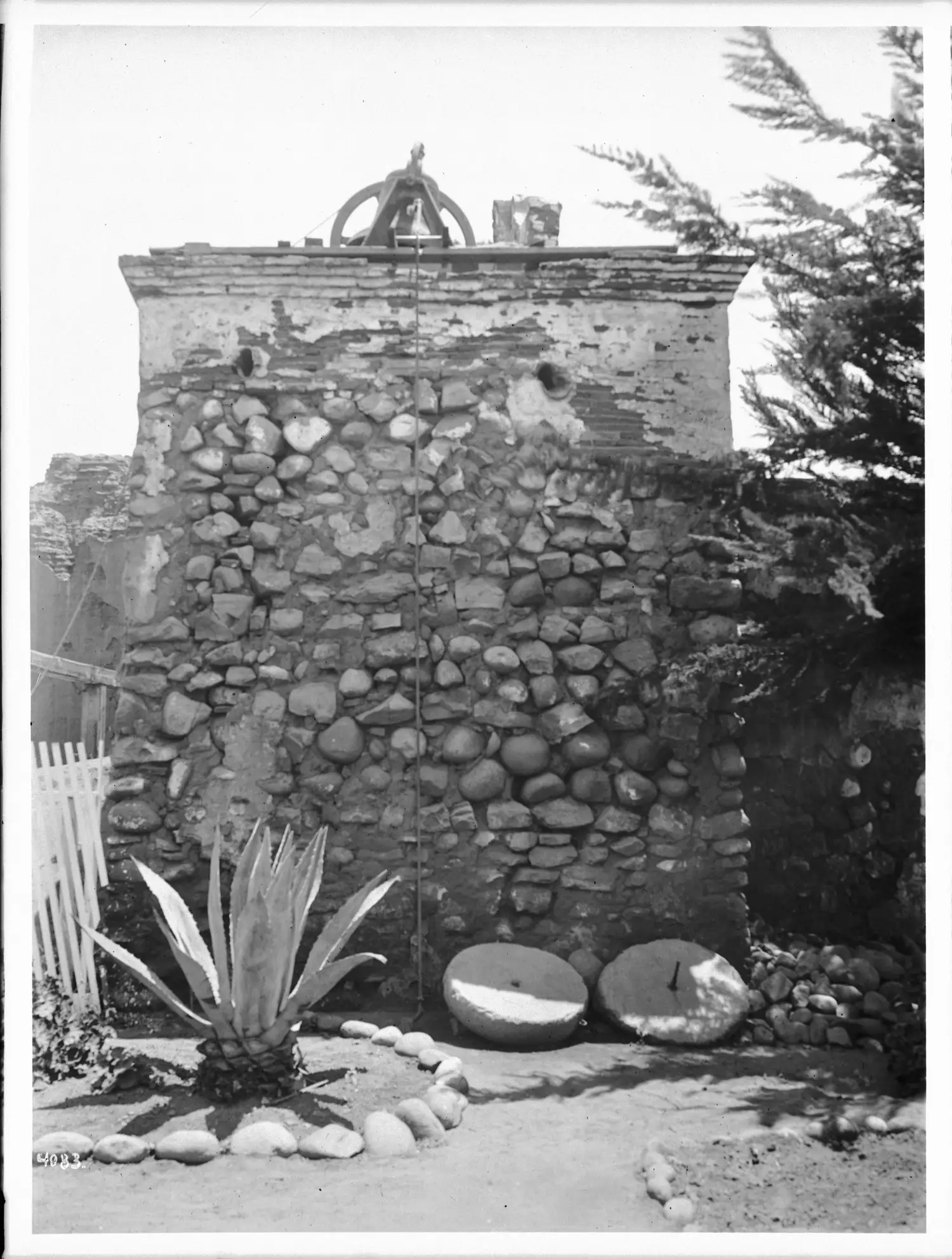
USC Digital Library, photo by George Wharton James, public domain; attribution not legally required, credited for provenance.
Six stops along the San Diego River
Mission Valley is a five-mile river corridor you drive or ride the Green Line trolley through, not a walking loop. The stops below run west to east, upriver, tracing the water the way it no longer runs, because the city moved it to build a stadium. Where the record and the legend disagree, both are told, and the copy says which is which.
1. Mission San Diego de Alcalá: A Revolt, a Killing, and a Poisoning the Signs Don’t Mention
What you’re looking at. The white facade at 10818 San Diego Mission Road, with its campanario, the pierced bell wall carrying five bells. This is a National Historic Landmark and an active Catholic parish. By the mission’s own count, the building in front of you is the fifth church to stand on this exact ground.
The killing, as it has been told for two hundred and fifty years. On the night of November 5th, 1775, somewhere between six hundred and eight hundred Kumeyaay people, drawn from as many as forty rancherias, came down on this mission, burned it, and killed the priest. That figure is the one everybody repeats, and nobody has traced it back to anything firmer than general circulation. Father Luis Jayme was thirty-five, a Franciscan since he was nineteen, and had learned the Kumeyaay language well enough to write a catechism in it. The story goes that when the mission was surrounded, he walked out toward the men who had come to kill him with his arms open, saying “Amar a Dios, hijos,” love God, my children. They seized him, shot him with something like eighteen arrows, and beat him until his face was gone. The story says his body could only be identified by his hands, the one part left untouched.
That detail is not quite what the man who actually found the body wrote down. Father Vicente Fuster, who survived the attack, wrote that Jayme’s face was so disfigured he could be recognized only by the whiteness of the flesh showing through the blood, and that the hands were simply the one part that was unwounded, not a fingerprint. A detail sanding itself smoother over two and a half centuries is not a lie. It is what a living tradition does to a story it loves, and every dramatic beat of it, the greeting, the arrow count, the identification, comes from the Franciscans’ own record of their own martyr, written up from the account of a man who spent the attack hiding in the barracks.
The Spanish punished the wrong people for the wrong reason, and it took two hundred years for anyone to say so in print.
What’s actually true. This was not a spontaneous mob. Two brothers from a village on this ground spent a month recruiting before the attack, and named leaders from at least seven villages met to plan it. What were they responding to? Baptisms had accelerated hard that year, nearly four hundred people in about ten weeks. Jayme himself, in his own letters, reported Spanish soldiers raping Kumeyaay women at two rancherias, in at least one case followed by murder, and grazing cattle on Kumeyaay farmland. One historian who has spent decades on the Spanish investigation’s own record calls the revolt “a rational, and calculated reaction to increased conversions, rapes, thefts, transmittal of diseases, and fear of forced imprisonment.” Three years later, the story usually jumps to a tidy ending: four Kumeyaay leaders tried and executed at the Presidio, generally called the first public execution in California history. That part is wrong. A sergeant marched four men here in shackles under a sentence to die the next morning, and it never happened, not through mercy, but because the sentence exceeded what the officer who ordered it was legally allowed to impose. A nineteenth-century historian misread the execution order as a record that it had been carried out, and the mistake sat uncorrected in the histories for more than a century, until a pair of journal articles in 1997 and 2017 ran it down.
The poisoning nobody tells you about. In November 1811, thirty-six years after Jayme, a Kumeyaay mission cook named Nazario put poison in the soup of Father Pedro Panto. Panto did not die that night. It took him seven and a half months, and he is buried in this same church, the second Franciscan to die violently on this ground. The only reason we know about it is a Franciscan historian who transcribed the case file in 1920, reluctantly, under a chapter heading that reads, without ceremony, “Death of Fr. Pedro Panto, Poisoned by Cook.” When Nazario confessed, he said he had been flogged the day before, claiming up to two hundred lashes in twenty-four hours. The order’s own historian called that number “too absurd to need disproval,” while separately admitting Panto’s cruelty “was not proved.” The soldier assigned to defend Nazario argued, on the record, that the poisoning was justified. What became of Nazario afterward, his sentence, his fate, even a baptismal name if he had one, is not in any source located for this page.
A silence, not a haunting. Somewhere on these grounds is the mission’s Kumeyaay cemetery. Ask three respected historians where it is and you get three different answers. Ask the two men who excavated this exact ground for nearly twenty years and you get nothing. “No, I’m not going to discuss it with you,” one told a reporter in 1986, and hung up. A local archaeologist who worked the dig as a student said, under his own name, that “it was common knowledge we were in a cemetery,” and that he saw bones himself. In 1984 a docent learned a parking lot was planned over ground where excavated ruins had sat since the 1970s, and fought it publicly enough to nearly cost the diocese its permits. Whether there are bodies under this ground is something no source will say in either direction, because nobody who could have answered it in 1986 would.
One name, and the village underneath it. The Kumeyaay village this mission was rebuilt beside in 1774, for the water and the farmland, has six recorded spellings across two hundred and fifty years, and, in a Kumeyaay author’s own spelling today, Cosaay. Kumeyaay scholars writing in the same historical journal that carries the mission’s own history have answered the mission’s marker directly. An Iipay scholar whose own great-great-grandparents were forced from their village in 1903 writes: “San Diego and the Mission San Diego de Alcalá were built on the village site known as Cosaay. Where are the statues and celebrations to the First People from Cosaay?” Both the mission’s own telling and these answers to it are published in the same place, about the same ground, and neither gets the last word here by default.
The skeptic’s corner
The 1775 attack, the three deaths on this ground, and the mission’s baptism and burial registers are documented without dispute. The dramatic details of Jayme’s martyrdom trace to a single interested source, his own order’s devotional record, and one specific detail, identification by his hands, is directly contradicted by the closest surviving eyewitness account. The widely repeated 1778 execution is a documented historical error, not a cover-up. Nazario’s poisoning of Panto rests on a primary criminal case file; the number of lashes he claimed is disputed by the order’s own historian. The cemetery’s location is unresolved on purpose, by the people who could resolve it.
2. San Diego Stadium: The City That Moved a River
What you’re looking at. A parking lot off Stadium Way. Not a field. The stadium where the Chargers played for half a century stood about a football field east of here and is gone, taken down in pieces between December 2020 and March 2021. Before any of it went up, engineers picked the San Diego River up and moved it, roughly two and a half million cubic yards of dirt, so a stadium could go where the river used to be.
Documented. Groundbreaking was December 18th, 1965. It opened August 20th, 1967, assembled from 1,715 pieces of precast concrete in 2,345 shapes, some weighing 39 tons. The building carried four official names, San Diego Stadium, Jack Murphy Stadium, Qualcomm, SDCCU, plus one more for ten days in December 2011: “Snapdragon Stadium,” a marketing tie-in for a phone chip the mayor agreed to unilaterally, without City Council approval and against the advice of the City Attorney’s office. That temporary, legally shaky name is the one on the building today, made permanent eleven years later on a different building next door. The Chargers announced their move to Los Angeles on January 12th, 2017. San Diego State bought 135 acres for 88 million dollars in 2020, and what is rising in its place is an eighty-acre campus with a thirty-four-acre river park on city land.
There is no ghost tradition at this site, and none should be invented. What this ground has instead is a habit older than the stadium: people pulling over to watch Mission Valley do something dramatic. You will meet it again two stops down.
3. Mission Valley Mall: The Engineers Who Chose Which Floor to Lose
What you’re looking at. 1702 Camino del Rio North, the original May Company store, anchoring a center now branded simply Mission Valley. Walk into the parking. It is underneath you.
The story. The thing everybody in San Diego “knows” about this mall is true: the parking is underneath because the valley floods. The real story is colder than the rumor and better. The engineers who built this did not decide the site was safe. They decided which floor they were willing to lose. The San Diego Union, quoted in a 1971 historical account, described what May Company did in 1965: built a riprap around the center, put the parking underneath and the shops on the second level, and installed pumps that run constantly. Their own 1965 prediction was that in a major flood the parking level would sit under about five feet of water. No flood has ever tested it.
An argument nobody has settled. For decades the design credit went to architect Frank L. Hope, whose firm’s name is also on the stadium. In 2015 a different architect, William S. Lewis, Jr., told a city historian on the record that he designed the building and Hope was “merely a figurehead” who “didn’t do anything.” Hope is dead. His firm’s name is on the permits, which proves who filed the paperwork, not who drew the plans. In December 2015, the city found the building “would have met Criterion D, Master Architect… but its various alterations have reduced the building’s integrity to below a level of significance.” Found important. Failed anyway, for having been remodeled too many times.
No ghost tradition here either, consistent with the rest of this valley. A seasonal haunted-house attraction operates in the mall’s parking structure every October; it is openly theatrical and makes no historical claim about the building itself.
4. Hotel Circle: Thirty Buildings, and the One the City Decided to Save
What you’re looking at. 500 Hotel Circle North, a resort with roughly thirty permanent buildings, a dozen of them over fifty years old. In 2016 the City of San Diego looked at all of it and decided exactly one building was worth protecting: not the founder’s original 1953 hotel, not the ten-story tower, but a single low ballroom ringed with parabolic concrete arches, built in 1967 for a different hotel that went bankrupt seven years later.
Documented. The founding is on the record four different ways, and none of them fully agree: the city’s 2016 report says 1953, forty-six units, developer Charles Brown; the resort’s own history calls it “a meager 40-room roadside lodge.” Even Brown’s death year is disputed, 1966 in two sources, 1967 in the city’s own report. The city’s own staff report lays out an uncomfortable sequence: Brown got his early zoning by promising low-density, “rustic, landscaped, garden-themed” hotels to preserve a rural character in the valley, and two sentences later in the same report, “the low-density concept… was quickly abandoned” when developers requested multistory zoning in 1963. What survived long enough to get protected is the Le Baron Hotel Garden Ballroom, designated in March 2016 under the informal name it carried at construction, not its current name as the Regency Conference Center.
Told, not verified. The resort’s own published history says Muhammad Ali trained here for his 1973 fight against Ken Norton, that a ninth-floor club called the Jabberwocky drew celebrities with Wolfman Jack sometimes DJing, and that a joke marquee once caught the New York Times‘s attention. None of those has been independently checked in this pass. That does not mean they are false. It means you should hear them exactly as they arrive, as the resort’s own account of its own history. One layer of the legend does hold up outside the hotel’s own telling: the original Tiki-and-Ranch style and founder Charlie Brown’s fondness for Hawaii are independently confirmed by both a local historian and the city’s own 2016 report.
No ghost tradition here. One guest review is headlined “STAY AWAY! THIS PLACE IS HAUNTED!!!!!,” but its actual text complains about dated furnishings, not paranormal activity.
5. The Rainmaker’s Flood, January 1916
What you’re looking at. The valley floor, and nothing you can point at. This stop carries no address and no pin, on purpose. The hospital this story turns on no longer exists, and no source located names its address, parcel, or footprint.
The story. In December 1915 the San Diego City Council voted to pay a man ten thousand dollars to make it rain. Charles Hatfield did not wait for the contract to be signed. He built a platform, set off his chemicals, and on January 16th, 1916, it started raining and did not stop for four days. Then this valley went under. The vegetable gardens and homes of the Chinese and Japanese farmers who worked this bottomland were wiped out, in the only place in this neighborhood’s entire research file where those communities appear at all. The city lost ten of its twelve wells. Police and Navy militia took families out by flat-bottomed boat. In a hospital somewhere on this floor, one built to hold people the rest of the city did not want living near it, staff carried patients up one flight of stairs and waited to see how high the water would come. While that was happening, a Union editor wrote that the water flowing into the reservoirs “offset one-hundredfold the damage to property, private and municipal.”
The second storm was worse. The Otay Dam failed on the 27th, and twenty-three people died. Hatfield sued for his ten thousand dollars; the city attorney offered to pay in full if Hatfield signed a statement taking responsibility for the flood. He refused, and was never paid. About the hospital itself: it treated tuberculosis, syphilis and other infectious disease, and was also called the Women’s Detention Hospital. One named eyewitness, interviewed decades later, recalled women being “picked up” and taken there for venereal-disease treatment, hedging his own memory with “I guess” even as he said it. Nobody detained there is named in any source found, and nobody should go looking.
Across the valley on the opposite rim, hundreds of people gathered at a cliffside garden to watch the river do this. That habit is documented at both ends of a hundred and fifty years, and it is a better story than a haunting, because nobody had to invent it.
6. The Foot of Sandrock Grade: A Murder, October 1895
What you’re looking at. Road, and the slope the old grade climbed out of the valley on. Nothing else. The store this happened in burned to the ground around July 1900. Neither the store nor the ford it stood beside has ever been resolved to a precise point. There is nothing to stand in front of.
What happened, documented. In 1895 this was the crossing: a sand ford farmers packed with straw every summer, and a five-room store with a sign reading C.W. Sandrock’s Tienda. On a Saturday morning in October, an old man named William Terry walked down the hill for a box of yeast and found the woman who ran the store dead on her own floor. Her name was Anne A. Sandrock, fifty-three, born in Germany. She and her husband Clemens had come to this valley by 1878; he built the store and the grade took the family’s name, then the couple separated in the late 1880s and Anne stayed on alone.
The coroner’s inquest transcript survives. A physician testified to knife wounds at her throat and a blunt injury to the back of her head, and gave his opinion she had been struck unconscious first. Her purse had been emptied, but forty-five dollars hidden in a bedroom trunk was left untouched, and the store key was missing. Two Kumeyaay men testified as witnesses through an interpreter, and the coroner and district attorney returned to nearly every witness with some version of the same question: “Are there any Mexicans or Indians living near here?” Anne’s twenty-one-year-old daughter Emma, who had just identified her own mother’s body, said no, every time. Her mother had trouble with nobody, Emma said, and traded with everybody.
“Anne A. Sandrock, native of Germany, 53, merchant, died of wounds inflicted by parties unknown.”
What’s actually true. Three men were chased into the mountains for having ridden fast that day. Two were caught and released for lack of evidence. A fourth, Juan Jose Hillario, was arrested on an informant’s tip, found with money and a handkerchief Emma identified as her mother’s, and testimony he had been spending coins downtown. He was convicted and sentenced to life. Whether that conviction was sound is not something this page can settle from what survives, and it will not guess in either direction. That is the official verdict recorded above, filed at the same time Hillario was arrested and tried.
The told version, sixty-four years later. Eugene Skinner sat for an interview with the local historical society in March 1959. He had been a small boy in 1895, and his father took him to see the store the next morning. “I faintly remember the Sandrock murder,” he said. “Mrs. Sandrock, as I remember it, was murdered there by an Indian that came down the valley that night.” Hold that against the 1895 transcript and it disagrees twice, on the time of night and on who the jury actually convicted. That does not make Skinner a liar. It is what sixty-four years does to a memory in a valley where the coroner kept asking that question out loud. Both his 1959 account and the 1895 record are given here on purpose, because watching a story drift is more honest than pretending it never did.
One more fact, handed over flat. Almost five years after the murder, on a July night, Anne Sandrock’s old store burned to the ground. The cause was never determined, and no source located since has connected it to the murder. You can do that arithmetic yourself if you want to.
The skeptic’s corner
The murder, the inquest, the sworn medical testimony and the official verdict all come from the coroner’s inquest transcript itself. Hillario’s arrest, conviction and life sentence are documented; his guilt or innocence is explicitly not adjudicated here. Eugene Skinner’s 1959 account is a named oral history that demonstrably drifted from the contemporary record, and it ships alongside that record rather than in place of it.
Frequently asked questions
Is Mission Valley haunted? There is no traceable ghost tradition anywhere in Mission Valley. Fourteen separate research passes across this river corridor turned up documents, lawsuits and disasters, and a sweep of what San Diego ghost tour operators actually publish found no haunted itinerary running through the valley at all. What the record does hold is a 1775 killing, a priest’s poisoning in 1811, and an 1895 murder.
What happened at Mission San Diego de Alcalá in 1775? On the night of November 5th, 1775, Kumeyaay people from villages on and south of the San Diego River attacked and burned the mission and killed Father Luis Jayme. Spanish investigators found it had been organized over roughly a month by named leaders from at least seven villages, in response to accelerating baptisms, documented assaults by Spanish soldiers, and cattle grazed on Kumeyaay farmland.
Were four Kumeyaay leaders executed in 1778? No. Four men were sentenced to die, but the sentence exceeded the ordering officer’s legal authority and was never carried out. A nineteenth-century historian misread the execution order as a record of a completed execution, and the mistake was repeated in print for more than a century until journal articles in 1997 and 2017 traced it back.
Who poisoned Father Pedro Panto in 1811, and what happened to him? A Kumeyaay mission cook named Nazario put poison in Panto’s soup in November 1811. Panto took seven and a half months to die and is buried in the mission church. The case survives through a 1920 transcription by a Franciscan historian; what became of Nazario afterward is not recorded in any source located for this page.
Who killed Anne Sandrock in 1895, and was anyone convicted? Anne Sandrock, who ran a store at the foot of Sandrock Grade, was found stabbed and beaten to death in October 1895. Juan Jose Hillario was arrested, convicted and sentenced to life based on money and a handkerchief found in his possession. The soundness of that conviction is not something the surviving record can settle either way.
Why is the parking underneath the Mission Valley mall? Because the valley floods and the engineers planned for it. In 1965 May Company built a riprap around the center, put the parking underneath and the shops on the second level, and installed pumps that run constantly. Their own published prediction was that in a major flood the parking level would sit under about five feet of water. No flood has tested it.
Exploring other neighborhoods? The Gaslamp Quarter and Old Town are both stops on our nightly tours. Point Loma, Balboa Park and North Park and Golden Hill aren’t tour stops either, but each carries its own documented history and legend. Nor are Coronado, Downtown, the Embarcadero, Hillcrest and Bankers Hill, La Jolla, Little Italy, and Mission Hills, each with its own documented history and legend: Coronado, Downtown, the Embarcadero, Hillcrest and Bankers Hill, La Jolla, Little Italy, and Mission Hills.
Want a guide to walk you through the Gaslamp Quarter and Old Town after dark? Our Gaslamp and Old Town Haunted Ghost Tour covers both nightly, told by a host who will name the source for you on the spot.
Sources
- National Historic Landmark and National Register of Historic Places, reference 70000144, Mission San Diego de Alcalá, designated 15 April 1970. California Historical Landmark #242.
- Msgr. Francis J. Weber, “The Death of Fray Luís Jayme: Two Hundredth Anniversary,” Journal of San Diego History, Winter 1976, Vol. 22 No. 1.
- Zephyrin Engelhardt, O.F.M., San Diego Mission (San Francisco: James H. Barry Co., 1920). Transcribes Fr. Vicente Fuster’s account of Jayme’s death and the case file headed “Death of Fr. Pedro Panto, Poisoned by Cook.” The single source for nearly every dramatic beat of the martyrdom account, and the Franciscan order’s own record of its own man, written by a historian who states his own reluctance to transcribe the Panto case at all.
- Richard L. Carrico, “Sociopolitical Aspects of the 1775 Revolt at Mission San Diego de Alcalá,” Journal of San Diego History, Summer 1997, Vol. 43 No. 3; and “Castigating the Insolent Ones: Native Resistance and the Spanish Military, The Pa’mu Incident,” Journal of San Diego History, Spring 2017, Vol. 63 Nos. 3 and 4. Source of the revolt’s organization, causes and geography, and of the documentary correction of the 1778 execution error.
- Deacon Andrew (Andy) Orosco, “A Kumeyaay’s Reflection,” Journal of San Diego History, Summer 2019, Vol. 65 No. 2. Kumeyaay-authored, first-hand.
- Dr. Theresa Gregor, “Decolonizing San Diego’s History: An Iipay Reflection on the Context and Impact of 1769,” Journal of San Diego History, Summer 2019, Vol. 65 No. 2. Kumeyaay-authored; source of the village name Cosaay and the closing quotation.
- Antonine Tibesar, ed., Writings of Junípero Serra (Washington: Academy of American Franciscan History, 1955), 2:407, for Serra’s quoted letters.
- Neal Matthews, “San Diego Mission’s oldest remains covered up / History paved over,” San Diego Reader, 20 February 1986. Source of the cemetery dispute, the named and unnamed archaeologists, and the three-way disagreement over its location.
- Mission San Diego de Alcalá published historical materials, for the “chose to be baptized” marker text, quoted rather than paraphrased.
- Nan Taylor Papageorge, “The Role of the San Diego River in the Development of Mission Valley,” Journal of San Diego History, Spring 1971, Vol. 17 No. 2. Load-bearing across four stops: the river diversion for the stadium, the San Diego Union of 18 July 1965 on the mall’s flood engineering, the 1916 flood coverage, and the flood-viewing tradition on the opposite rim.
- City of San Diego Digital Archives, Historical Photos, “San Diego Stadium Under Construction in 1967,” photograph dated 21 July 1967. The city’s own caption gives architects, contractors, groundbreaking and opening dates.
- Curt Smith, “Jack Murphy Stadium (San Diego),” SABR BioProject, 15 May 2018.
- “San Diego Stadium,” Wikipedia. Load-bearing for the post-1997 chronology, attributed here to its own cited sources, chiefly contemporary San Diego Union-Tribune reporting for the 2011 renaming dispute.
- State of California DPR 523 form and Historical Resource Research Report, “1702 Camino Del Rio North, San Diego CA 92108,” recorded December 2015, incorporating Scott A. Moomjian’s November 2015 telephone interview with architect William S. Lewis, Jr.
- City of San Diego, Report to the Historical Resources Board HRB-16-009, 17 March 2016, covering both the Camino del Rio North finding and the designation of the Le Baron Hotel Garden Ballroom.
- “Mission Valley (shopping mall),” Wikipedia, for the opening date and ownership chronology, attributed to its own cited Union-Tribune reporting where load-bearing.
- Martin S. Lindsay, “Town and Country Motor Hotel,” Classic San Diego, 8 July 2021.
- Town and Country Resort, “Town and Country Resort’s History,” the property’s own published timeline. Owner-authored; its celebrity claims are named as the resort’s own account wherever used and have not been independently checked.
- San Diego Architectural Foundation, Orchids and Onions, Orchid citation, “Town and Country Resort.”
- U.S. Secretary of the Army, Chief of Engineers, San Diego River (Mission Valley) California (1965), for peak flow and damage figures, read through source 9.
- Shelley J. Higgins, This Fantastic City San Diego (1966), pp. 176-183, the city attorney’s own memoir and the origin of the “go to hell” exchange, read through source 9, whose author flags its bias in print.
- Barbara Palmer, “Life Along the San Diego River,” San Diego Reader, 25 July 2002, carrying a 24 October 1995 oral history interview with Fritz Ohre. Source of the detention hospital recollection and the Skinner quotation.
- Mrs. James Minor, interviewed by Nan Taylor Papageorge, San Diego, May 1968, for the 1927 flood recollection.
- Barbara Palmer, “Pioneer woman Anne Sandrock killed in Mission Valley,” San Diego Reader, originally published 25 January 2001, republished 8 October 2025. Reproduces the coroner’s inquest transcript at length; the primary document the 1895 stop rests on.
- Eugene Skinner, oral history interview conducted by Edgar F. Hastings, 24 March 1959, San Diego Historical Society Oral History Collection, quoted through source 23.
- Published inventories and itineraries of San Diego ghost tour and haunted-attraction operators, swept for any Mission Valley content across fourteen research passes and again in September 2026. The absence is the finding, named here as a category rather than individually.
Take the tour
- Haunted San Diego Ghost Bus
- Gaslamp and Old Town Haunted Ghost Tour
- Paranormal Investigation History Tour
- Private Group Tours