

San Diego’s Embarcadero is the most heavily worked mile of ghost tour ground in the city, and that is exactly why most of what gets said on it is thin. Six or more operators stop at the same two ships, the claims get copied sideways between them for years, and somewhere in that game of telephone a man died in a chain locker in 1909 with no name, no date past the year, and no document anyone has ever produced. This page is built from a Library of Congress oral history, a museum curator’s own public talk, a 2018 newspaper interview, National Register listings and a 2016 history journal article, not from twenty years of copied blog paragraphs. Eight stops, walking south from the County Administration Center to the Top Gun bar near Seaport Village, told from the documents rather than from the listicle.
Where a document and a legend disagree, both stay on the page. This walk is not currently a stop on any Haunted San Diego Ghost Tours route; our nightly tours run in Old Town and the Gaslamp Quarter. This page is a sourced guide to the waterfront’s real history and its real, honestly hedged ghost stories, told exactly as that.
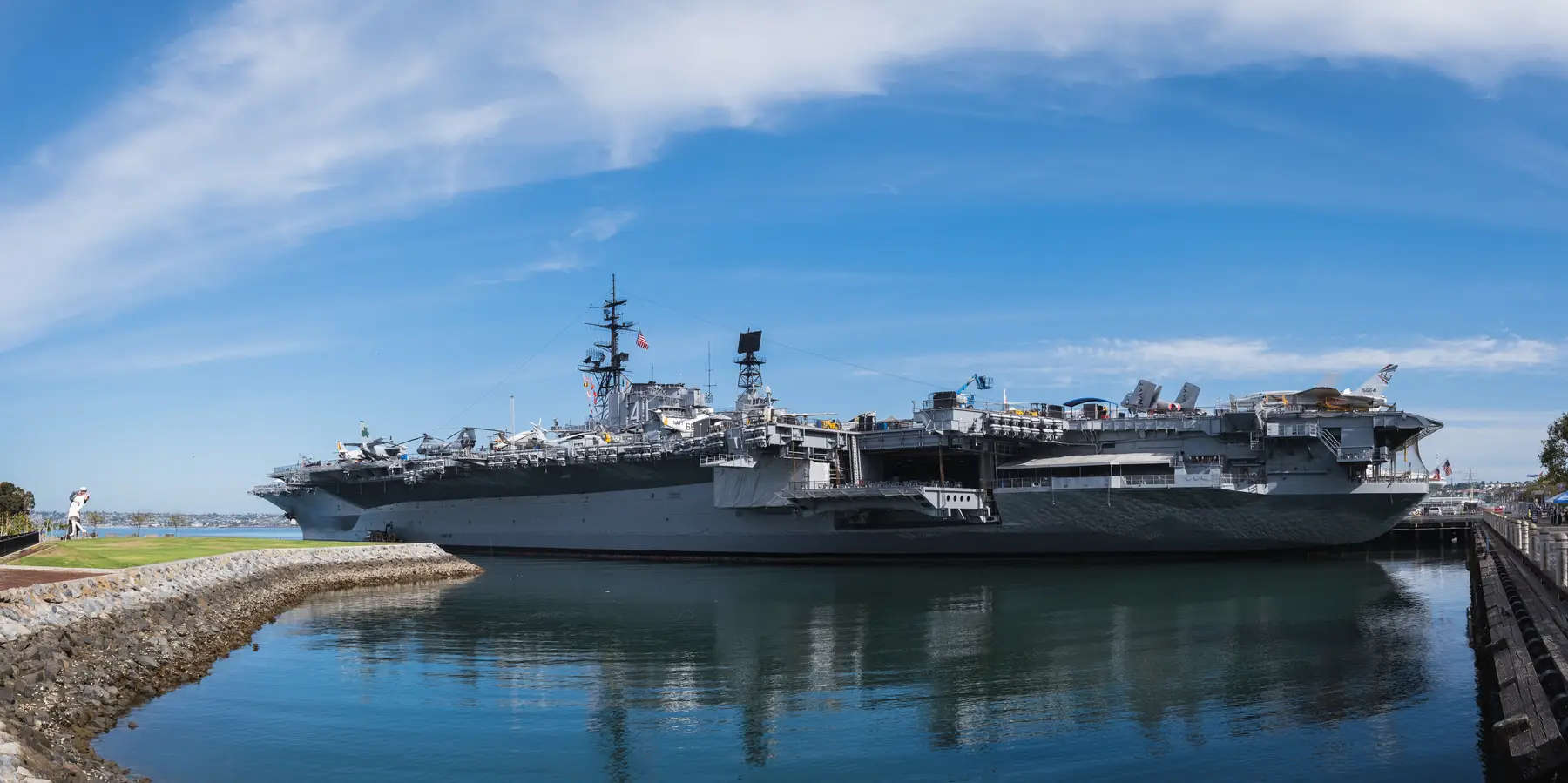
“USS Midway (CV-41) museum ship, panorama, San Diego, California” by Christian David, CC BY-SA 4.0, via Wikimedia Commons.
The eight stops
1. The County Administration Center, the Jewel on the Bay
What you are looking at. The white tower with the red tile roof at 1600 Pacific Highway, standing on ground that used to be open water. Locals call it the Jewel on the Bay, with Waterfront Park running out in front of it.
The real history. San Diego spent three decades arguing about this building before anyone poured a footing, and the loudest part of the argument was about earthquakes. It started in 1908, when planner John Nolen put a civic center downtown in his plan for the city, and voters said no. Nolen came back in 1926 with a different idea: build it on newly dredged tidelands instead, out on the bay itself. Voters said yes in March of 1927, and the argument changed shape rather than ending. A heavy masonry government building, going up on dredged mud rather than solid ground, looked to a lot of San Diegans like exactly the kind of thing that comes down in the next real earthquake. The engineers answered it by driving thirty-foot steel pilings under the whole site, some deliberately alternated to handle sideways stress, an arrangement a later engineering survey called “on the cutting edge of engineering developments” for its time.
The Depression slowed everything down. Construction did not start until 1935, funded with a million dollars of federal WPA money on top of local funds, and it was not finished until December of 1938. President Franklin Roosevelt dedicated it in July of that year anyway, in front of a crowd estimated at twenty-five thousand people, five months before the building was actually done. Four architects worked on it together, producing a deliberate mix of Spanish Revival and Beaux-Arts styling to match Balboa Park, with a 1930s-modern tower on top. On the harbor side stands a fountain sculpture called Guardian of Water, and inside, the murals are painted in egg tempera, a medium out of thirteenth- and fourteenth-century Italy, on the walls of a 1930s American county building.
What is actually true. No ghost story has ever attached itself to this building. We looked specifically, because a decades-old county government building is exactly the kind of place this trade normally works hard, and there is nothing here. One sourcing note: the building’s own WPA funding is confirmed from multiple directions, but whether the Guardian of Water fountain itself, as opposed to the building generally, drew WPA money rests on a single archival registry entry and nothing else located.
2. Star of India: the stowaway nobody can name
What you are looking at. The tall ship with the black iron hull at 1492 North Harbor Drive, Maritime Museum of San Diego. Her hull, cabins and fittings are almost entirely original, meaning most of what stands in front of you is the actual iron that was there a hundred and sixty years ago.
The real history. She is one of the oldest ships in the world still sailing, and that is where the disagreement starts: her own museum calls her the oldest, full stop, and the National Park Service’s own listing calls her the second-oldest. Neither source is a tour company, and this page is not picking a winner. What is not in dispute: launched in 1863 on the Isle of Man, and her early years nearly ended her. On the way to Calcutta in 1864 she hit an unlit Spanish brig off the coast of Wales, and the crew mutinied rather than keep sailing; seventeen of them did hard labor in a Welsh jail for it. A storm the following year took her masts off entirely in the Bay of Bengal. Her first captain died on the voyage home and was buried at sea; the sources that mention his death do not say what killed him, and the detail some tellings add, that it was fever, does not trace to anything.
Then she settled into the work that actually defines her: twenty-five years carrying emigrants from England to New Zealand, twenty-one full crossings, families living aboard for months at a time, children born at sea. In 1901 she was sold to an Alaskan salmon-canning company, renamed Star of India in 1906, and spent twenty-two years hauling cannery crews north and canned salmon south. San Diego bought her in 1926 to anchor a museum, and then the Depression and the war happened, and she sat rotting in this harbor for thirty years. What saved her was a passing windjammer captain named Alan Villiers, who saw her decaying and made enough noise that citizens organized to restore her. She sailed again in 1976, and still sails today.
The ghost story. In 1884, a stowaway boy lost his footing somewhere up in the rigging and fell about a hundred feet to the deck. Both legs shattered. He lived three days. What is told now is that he never really left: people describe a presence in the rigging and on the foredeck that feels young rather than frightening, and more than one visitor has described a hand on the shoulder up there. We looked hard for a name to give him. The record is a mess: he is called John Campbell in one telling and Oswald Letts, at a different age entirely, in another, and those two people cannot both be the same boy. So this page tells the fall, because the fall is real, and says honestly that nobody has settled who he was. There is a second, separately told story set in the ship’s chain locker, that a man died there in 1909, either crushed by the anchor chain or, in a darker telling some operators prefer, killed by another person. No name, no document, and no date more precise than the year has been located behind either version; the darker version is not repeated here because it accuses an unnamed person of homicide with nothing behind it but the story.
One thing this page will not turn into ghost content: a volunteer died aboard this ship in 2010 during a safety exercise. It is documented, it is recent, and he has living family.
3. The steam ferryboat Berkeley: the man in the fedora
What you are looking at. The large white ferry at the same dock, serving today as the Maritime Museum’s own main building. Visitors walk through her to reach everything else.
The real history. Built in 1898, the first propeller-driven ferry on the West Coast rather than the older paddle-wheel design, and by her owner’s own account the largest commuter ferry in the country at the time. When the 1906 San Francisco earthquake hit, she ran for three straight days and nights moving refugees across the bay to Oakland while the city she’d been built to serve burned behind her.
The ghost story, and where it actually comes from. The museum’s own Director of Marine Operations, Jim Davis, told the San Diego Union-Tribune in 2018 exactly what he saw late one night on the upper deck: a man leaning in a doorway near the deck once known as the Ladies Deck, wearing a trench coat and a fedora. He told the man to leave. When the man did not move, he walked toward him, and the man was simply gone. Davis was not the first to describe that exact figure. Ten years earlier, in December of 2008, a national television crew investigated this ferry and broadcast an episode naming the same apparition in the same trench coat and fedora, before the museum’s own officer had said a word about it publicly. A named museum employee, on the record in the local daily, corroborated something already in national circulation, rather than inventing it.
The real death underneath it, and where the story splits. On January 13th, 1911, nitroglycerin that a passenger was carrying in his own pocket went off aboard this ferry, killing one person and injuring five. The dead man is named as John O. Norbom, a miner, by more than one source, though they cannot agree on the spelling. Past that point the story splits into incompatible versions, and this page shows the seams rather than stitching them: one operator’s telling adds a second death from injuries, spelling that man’s name two different ways on the same page; the same operator’s telling has the family alleging Norbom was murdered, the nitroglycerin planted rather than carried, sourced to no document and no named person. That same operator also dates an unrelated, checkable collision involving this ship to 1890, on the same page that gives the ship’s own launch year as 1898, eight years before she existed. A different operator gets that same underlying event right: 1900, a different vessel, a signal misunderstanding. That is useful information about which teller to weigh more heavily, and it is still not a reason to treat either one as documented history.
4. USS Midway: the day they pushed the helicopters into the sea
What you are looking at. The aircraft carrier at 910 North Harbor Drive, Navy Pier, a thousand feet of flight deck open to the public.
The ghost story, and where it actually comes from. Almost every “haunted San Diego” list mentions this ship, and for once the lists are not the source. David Hanson has been the museum’s curator since December 2004, and in his own time he leads the largest paranormal investigation group in the county. In 2017 a local genealogical society announced a public talk by him, “Ghosts of the U.S.S. Midway,” describing accounts from staff, from visiting guests, and from nine months of his own investigation below decks. The museum published on the subject the following year, and the museum’s own library staff have logged ghosts by name in their own newsletter: one they call Monty, one named Jerome who sits in the third row of the theater, third seat from the left, and one called Chad, said to have served aboard in 1953. None of that makes a ghost real. What it settles is where the story actually comes from: the ship’s own staff, not an anonymous listicle. The curator’s own reading is worth repeating: he does not think these are people who died here, but former crew who came back to a place they loved.
The story that carries this stop without any ghost at all. On April 29th, 1975, during the helicopter evacuation of Saigon, this ship was one of the Navy’s main evacuation decks. A South Vietnamese Air Force pilot, Major Buang, got his wife and five children into a tiny two-seat observation plane never built to land on a carrier and flew out over open water looking for any American ship at all. He could not raise her by radio, so he dropped handwritten notes onto the flight deck asking permission to land. The deck was already packed with helicopters that had spent the day ferrying other refugees ashore. The ship’s commanding officer, Captain Lawrence Chambers, made the call to clear the deck. Crews pushed roughly forty to fifty helicopters, the exact count is genuinely disputed, over the side and into the sea to open a runway for one small plane carrying one family. Major Buang landed it. That little plane is preserved today at the National Museum of Naval Aviation in Florida, and the deck it landed on is the same thousand feet people walk along this waterfront right now.
5. Unconditional Surrender: the woman who said no to the reenactment
What you are looking at. The twenty-five-foot sailor and woman in white at Tuna Harbor Park, just south of the Midway, the most reproduced photograph of the end of the Second World War.
The real history. Times Square, the afternoon of August 14th, 1945, the day word reached the crowd that the war was over. Life photographer Alfred Eisenstaedt caught four frames of it, and one became the image of a country exhaling all at once. For fifty years the argument about the photograph was who the two people were. Eisenstaedt never got their names and said so himself. Several men came forward over the decades claiming to be the sailor, and it is still argued about today; the most widely accepted identification is a sailor named George Mendonsa, and the woman is generally identified as Greta Zimmer Friedman, who was not a nurse at all, despite how the photo is usually described, but a dental assistant in a white uniform. That identification dispute is not settled here, because serious people still dispute it in public.
What almost nobody tells you. Friedman sat for a recorded interview about it, on the record, for the Library of Congress, in 2005. Asked what she felt when he grabbed her, she said: “I felt he was very strong, he was just holding me tight, and I’m not sure I, about the kiss because, you know, it was just somebody really celebrating. But it wasn’t a romantic event.” Asked if he said anything first: “No, no. It was just an act of silence.” Later in the same interview, she put it plainly: “it wasn’t my choice to be kissed. The guy just came over and kissed or grabbed.” In 1980, Life brought her and Mendonsa back to Times Square for an anniversary reunion and asked them to reenact the kiss for a camera. She said no: “I didn’t want to reenact the kiss.” She carried mixed feelings about the photograph for the rest of her life. She died in 2016. Mendonsa died in February 2019.
One correction, because this gets misremembered. The day after Mendonsa’s death was announced, someone spray-painted “MeToo” across one of these statues. That happened in Sarasota, Florida, on that city’s own copy of the sculpture, not here. Also worth knowing while standing here: what you are looking at is not the original. The 2007 installation was built with a foam core and urethane outer layer; the Port of San Diego voted in March 2012 to purchase a permanent bronze replacement, and the bronze version arrived on February 11th, 2013.
6. La Punta de los Muertos: the monument to an event that may never have happened
What you are looking at. A bronze plaque at the southeast corner of Pacific Highway and West Harbor Drive, beside the old police headquarters building. The point it names is gone, buried under landfill, and the shoreline has moved about a quarter mile west of where the marker stands.
The real history, and the dispute nobody resolves. San Diego County’s own Board of Supervisors put up this plaque in 1954, stating that sailors and marines were buried here in 1782, when Spain sent two royal frigates to chart the bay. The claim outlasted everything else on the ground: the encyclopedia repeats it, and a shopping village built to look old and sitting on the lot today repeats it too, adding that the men most likely died of scurvy, a detail the plaque itself does not give. In 2016, a history journal published an article specifically about this marker, titled “A Monument To An Event That Never Happened.” That article sits behind a paywall this research could not get past. What is available is a local writer’s summary of it, characterizing the article as saying the marker “is wildly inaccurate,” that no one died on that survey voyage at all, and that “dead men,” in old mooring language, most likely refers to buried logs used as ground anchors rather than corpses. This page is not picking a winner between the county’s 1954 plaque and a 2016 journal article relayed secondhand; both are named, with exactly who is speaking on each side.
7. Ruocco Park: the couple who were dead for thirty years before they won
What you are looking at. Three quiet acres at 585 West Harbor Drive, entrance at West Harbor Drive and Pacific Highway, entered under a forty-five-foot sculpture of split eucalyptus branches suggesting a sailboat’s mast and rigging.
The real history. In 1977, architect Lloyd Ruocco and his wife Ilse set aside money for a public park in downtown San Diego. Lloyd was the city’s leading Modernist architect and a founder of a good-government group still active today; Ilse taught at San Diego State. Their fund sat with a local foundation for over three decades while nothing happened on the ground it was meant for. Lloyd died in 1980 or 1981, the sources genuinely disagree which. Ilse died in 1982. The park their money helped build finally opened in September of 2012, thirty years after the second of them died and thirty-five years after they started the fund. This park sits on or immediately beside the same ground the Dead Men’s Point marker from the previous stop names; this page does not repeat that story here and is not asserting that anyone is buried under this lawn, only noting the geographic overlap the record shows.
8. Kansas City Barbeque: the piano that outlived the building
What you are looking at. 600 West Harbor Drive, the Top Gun bar, the sign out front says so.
The real history. This is the bar where Maverick and Goose sing “Great Balls of Fire” at the piano in Top Gun. A Kansas City couple, Martin and Cindy Blair, opened it as a Midwestern barbecue joint in 1983, in a downtown San Diego that didn’t have one yet. A location scout working for Paramount found it, liked what he saw, and brought it to director Tony Scott; the bar closed for exactly one day so the crew could film here, including the picture’s closing sequence. On June 26th, 2008, this building burned. The fire started in an open cooking pit in the kitchen and gutted the place; roughly forty-five firefighters took about twenty minutes to get it under control, and nobody was hurt. Most of the Top Gun memorabilia inside, four decades of it, was destroyed. The bar reopened that November. The actual upright piano from the “Great Balls of Fire” scene survived the fire that took nearly everything else in the building with it, and it is the single most photographed object in the place today.
Frequently asked questions
Is the Embarcadero in San Diego haunted? Two waterfront ships carry well-attested haunting accounts. Aboard the Star of India, visitors report a young presence in the rigging and on the foredeck, tied to a stowaway boy who fell about a hundred feet to the deck in 1884 and died three days later. Aboard the ferryboat Berkeley, the museum’s own Director of Marine Operations described a man in a trench coat and fedora vanishing from a doorway, in the local paper in 2018, a decade after a national television crew broadcast the same figure. The County Administration Center, by contrast, has no ghost story at all.
Is the Star of India haunted, and who is the ghost? Nobody has established who he was. The 1884 fall from the rigging is real. The name is not settled: one body of material calls the boy John Campbell, aged fourteen or fifteen, and another calls him Oswald Letts, aged eleven, and those cannot both be one person. Neither name traces to a primary document.
Is the USS Midway haunted? The claim comes from the ship’s own staff rather than tour marketing. The museum’s curator has led paranormal investigations aboard since the mid-2000s and gave a public talk on it in 2017, and the museum library’s own staff have written up ghosts they call Monty, Jerome and Chad, with described locations aboard. The curator’s own view is that these would be former crew returning to a place they loved rather than anyone who died there.
Were sailors really buried at Dead Men’s Point? It is disputed, and the dispute is the interesting part. A 1954 county plaque at Pacific Highway and West Harbor Drive says sailors and marines were buried there in 1782. A 2016 Journal of San Diego History article titled “A Monument To An Event That Never Happened” disputes it outright, arguing that nobody died on that survey voyage and that “dead men” refers to buried logs used as mooring anchors. That article has not been read directly for this page; the characterization traces to a secondhand summary. Both accounts stand.
Who are the two people in the kissing statue on the Embarcadero? The woman is generally identified as Greta Zimmer Friedman, a dental assistant rather than the nurse she is usually called, and the sailor is most widely identified as George Mendonsa, though that identification is still publicly disputed. Friedman recorded an oral history for the Library of Congress in 2005 in which she said the kiss was not her choice, and she declined to reenact it for Life magazine in 1980.
Does Haunted San Diego Ghost Tours run a tour on the Embarcadero? No. This page is a sourced guide to the waterfront’s real history, not a stop on any of our routes. Our nightly tours run in Old Town and the Gaslamp Quarter.
Want the history told out loud, on the street where it happened? Our hosts run that every night in Old Town and the Gaslamp Quarter. Book Now. For San Diego’s stories from the seat of a bus, see the Haunted San Diego Ghost Bus.
Exploring other neighborhoods? Downtown has its own walk: Downtown San Diego Ghost Stories. The Gaslamp Quarter runs nine stops: Gaslamp Quarter Ghost Stories. Old Town runs from the Whaley House to Heritage Park: Old Town Ghost Stories. Balboa Park, Coronado, Point Loma and La Jolla each carry their own sourced histories: Balboa Park, Coronado, Point Loma, and La Jolla. Hillcrest and Bankers Hill, Little Italy, Mission Hills, Mission Valley, and North Park and Golden Hill each have their own guides too: Hillcrest and Bankers Hill, Little Italy, Mission Hills, Mission Valley, and North Park and Golden Hill.
Sources
- Greta Friedman Collection, Veterans History Project, American Folklife Center, Library of Congress, interview by Patricia Redmond, 2005. Primary source for every word attributed to Friedman, read from the Library of Congress transcript.
- San Diego Union-Tribune, “Haunted San Diego: 11 scary places to get your spook on in San Diego,” October 12, 2018. Source of Jim Davis’s quoted account aboard the Berkeley, his job title, and the Ladies Deck name.
- National Park Service, “Star of India, CA” place listing. Source of the 1863 construction and the claim that she is the world’s second-oldest active sailing ship, in direct disagreement with the next source.
- Maritime Museum of San Diego, “Star of India” ship page. The owner’s own claim that she is the world’s oldest active sailing ship.
- Chula Vista Genealogical Society, program announcement for a October 25, 2017 talk by David Hanson, “Ghosts of the U.S.S. Midway.” Independent of both the museum’s marketing and the ghost-tour trade; source of Hanson’s role, his investigation group, and his account of how the investigation began.
- e-Quips, the USS Midway Museum library staff newsletter, “We Work on a Haunted Ship, in a Haunted Library,” October 31, 2019. Source of the named ghosts Monty, Jerome and Chad and their described locations aboard.
- USS Midway Museum, “Spirits of the Midway,” published on the museum’s own site in October 2018. Existence, date and title confirmed; the page returned a 404 error and could not be read directly this pass.
- Richard Schulte, “A downtown burial site at Dead Men’s Point?”, Cool San Diego Sights, December 17, 2020. Source of the verbatim 1954 marker transcription and the characterization of the 2016 journal article. Schulte is a downtown resident and photo blogger, not a historian; he is the teller of the rebuttal here, not its author.
- The Journal of San Diego History, “A Monument To An Event That Never Happened,” 2016, Vol. 62, Nos. 3-4. Not read directly; blocked behind a paywall on every method attempted. Everything attributed to this article reaches this page through the Schulte source above.
- California Office of Historic Preservation, Listed Resources detail for California Historical Landmark No. 57, designated December 6, 1932. Formal landmark history for La Punta de los Muertos.
- The Guardian, “MeToo daubed on kissing sailor statue day after serviceman’s death,” February 20, 2019. Source of the Sarasota location and the Sarasota Police Department’s own statement.
- Thomas G. Atkinson, “Civil Engineering for Buildings,” Journal of San Diego History, Winter 2002, Vol. 48 No. 1. Source of the County Administration Center pilings detail, reached at second hand through an encyclopedia paraphrase rather than read directly.
- County of San Diego, “County Administration Center History.” Corroborates the funding and construction figures independently.
- New Deal Art Registry, County Administration Center entry. Sole source for the Guardian of Water fountain’s WPA funding, named on this page as the weaker claim for that reason.
- National Register of Historic Places, reference 88000554, County Administration Center historic district, 16.7 acres, listed May 16, 1988.
- National Historic Landmark and NRHP reference 66000223, Star of India, designated November 13, 1966; California Historical Landmark No. 1030.
- Network recap of Ghost Hunters, Season 4, Episode 26, “Spirits on the Water,” aired December 3, 2008, investigating both the Berkeley and the Star of India. Establishes the trench coat and fedora apparition in national circulation a decade before the 2018 newspaper account.
- Wikipedia: “San Diego County Administration Center,” “Star of India (ship),” “Berkeley (ferryboat),” “USS Midway (CV-41),” “Operation Frequent Wind,” “Unconditional Surrender (sculpture),” “Greta Zimmer Friedman,” “La Punta De Los Muertos,” “Seaport Village,” and “Kansas City Barbeque.” Each fetched and read in full. Source of the Nolen plans and earthquake controversy, the Star of India‘s mutiny at Beaumaris Gaol and New Zealand emigrant figures, the Berkeley‘s 1898 construction and 1906 evacuation role, Major Buang’s note and Captain Chambers’s order, the kissing statue’s foam-and-urethane original and 2013 bronze replacement, the scurvy claim at Dead Men’s Point, and the Kansas City Barbeque fire and the piano’s confirmed survival.
- Los Angeles Times, “New San Diego park was 35 years in the making,” September 22, 2012. Source of the framing the Ruocco Park stop is built around.
- San Diego Union-Tribune, “Ruocco Park is 1st in a series of new downtown parks,” September 29, 2012. Source of the Ruocco death dates as this paper gives them and Lloyd Ruocco’s founding role in Citizens Coordinate for Century 3.
- San Diego Reader, “Stringers: eucalyptus art at Ruocco Park in Harbor District,” January 1, 2013, citing the Port of San Diego’s own site for the acreage figure and dedication date.
- The Cultural Landscape Foundation, “Ruocco Park.” Source of the park’s acreage, its prior use as a restaurant and parking lot, and the eucalyptus sculpture’s design.
- Kansas City Barbeque, “About,” the business’s own account of its 1983 founding and the Top Gun filming.
- KCUR, “Leaving Kansas City: Taking Kansas City BBQ to San Diego,” March 31, 2015. Corroborates the Blairs’ Kansas City origin.
- Published ghost-tour material for this waterfront, surveyed and named here as a category rather than individually, per this project’s standing practice for uncorroborated competitor claims. Sole source for the Star of India chain-locker death in both versions, both competing stowaway names, the Berkeley‘s disputed second death, and the murder allegation attributed to Norbom’s family. No document was located behind any of them.
Take the tour
- Haunted San Diego Ghost Bus
- Gaslamp and Old Town Haunted Ghost Tour
- Paranormal Investigation History Tour
- Private Group Tours