

Mission Hills does not have an old ghost tradition, and the honest version of that finding is more interesting than an invented one would be. What the neighborhood has instead is two burial grounds that are still full and no longer marked as burial grounds, sitting under a public park and a public lawn about a mile apart, plus a handful of twentieth and twenty-first century ghost stories carried by named local voices rather than by legend. This page separates the documented history of Pioneer Park, Presidio Park, the Junipero Serra Museum and the tower everyone calls the Witches Tower from what a small number of local storytellers, named wherever they could be traced, have actually said about each.
A plain note before the walk: Mission Hills and Presidio Park are not currently stops on any Haunted San Diego Ghost Tours route. Our nightly walking tour covers the Gaslamp Quarter and Old Town, below this hill. This page is a sourced guide to the neighborhood above it, researched from newspapers, archives and named sources, and told just as honestly.
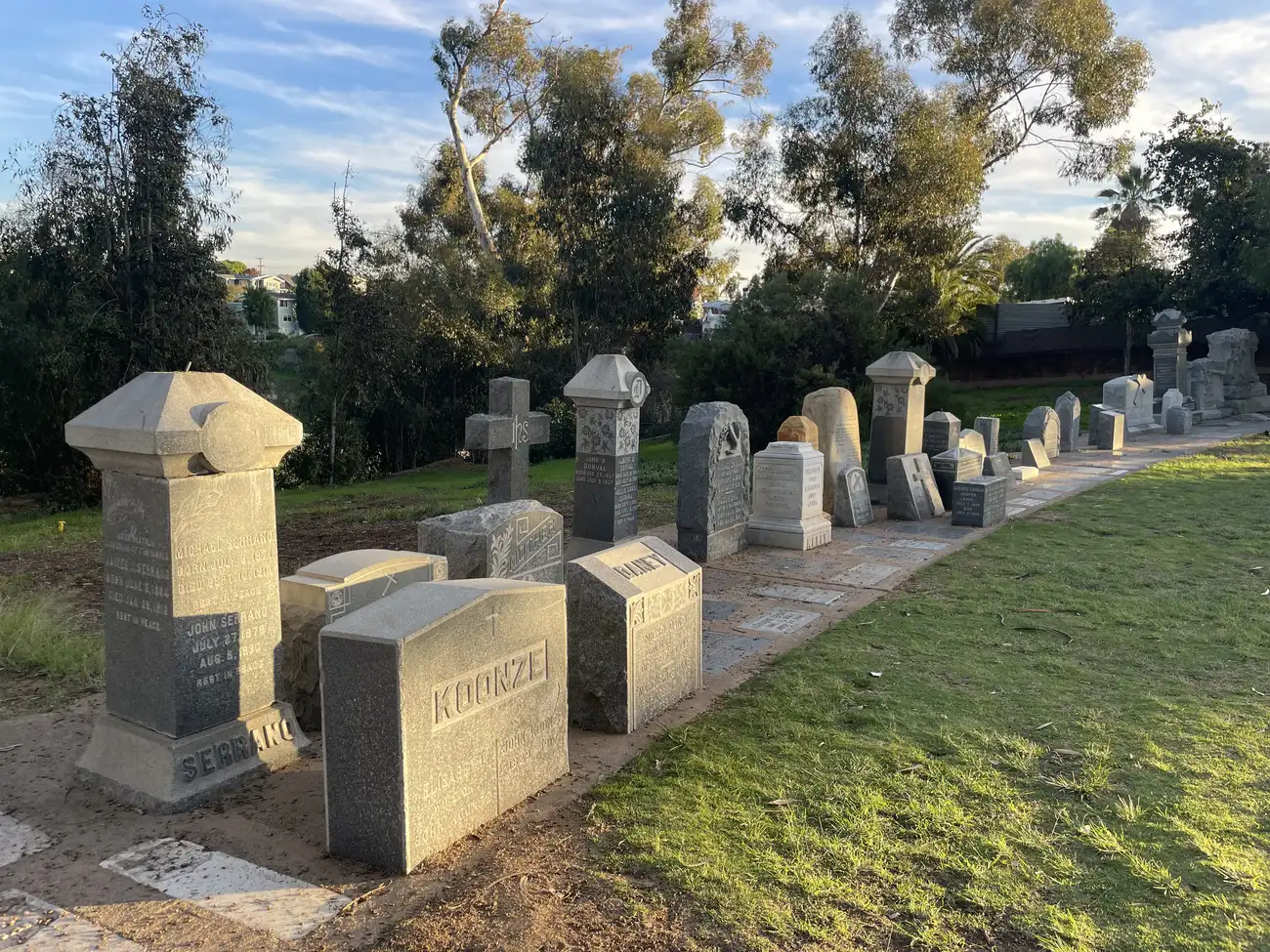
CC0 / public domain dedication by Blervis, via Wikimedia Commons; attribution not legally required, credited for provenance.
Five stops across Mission Hills and Presidio Park
The walk below starts at Pioneer Park, the converted cemetery on the neighborhood’s eastern edge, then moves up the hill to Presidio Park, where the city’s original fort lies buried under the grass. From there it visits the Junipero Serra Museum, the tower known locally as the Witches Tower, and a small, more recent local legend near the park’s overlook. Where the record and the legend disagree, both are told, and the copy says which is which.
1. Pioneer Park, the Cemetery That Is Still There
What you’re looking at. A bank of salvaged headstones in the southeast corner of a five-acre city park, nearest to Grant Elementary School. From there you can see the headstones themselves, six ground-level bronze plaques listing the interred, a remnant adobe wall along the park’s south and east edges, and, beyond them, a lawn, a playground and tennis courts. What you cannot see is that the lawn itself is a graveyard. It never stopped being one.
What the records say. The Catholic Diocese acquired five acres here from the City in October 1873 for a cemetery, land developer Joseph Mannasse having sold the underlying ten acres to the City the year before. Wikipedia dates the cemetery’s formal establishment to 1876. A 2005 research project by Grant Elementary School’s own fourth-grade seminar class says the first burial happened “some time in 1870. No one really knows for sure when.” The founding date is genuinely unsettled between 1870, 1873, 1874 and 1876, and this page does not pick one. Father Antonio Dominic Ubach, the Spanish-born priest San Diego called “the last of the California padres,” staked out the Catholic half in 1874 because El Campo Santo in Old Town was already full. The five-acre Protestant half was never used for burials at all; it became Mission Hills Park in 1909, and after Grant Elementary was built next door in 1914, on land once owned by Kate Sessions, the old Protestant tract served as the school playground.
Who is under the lawn. From about 1880 to 1920 the Catholic half was San Diego’s working cemetery. Father Ubach himself is buried here (d. 1907), along with Albert Vincent Mayrhofer, president of the California Historical Society and the man who led the 1930s restoration (d. 1948), Captain Cave Johnson Couts, West Point class of 1843, the same class as Ulysses S. Grant, buried beside his wife Ysidora Bandini, and the cemetery’s own caretaker, Peter O’Malley of County Mayo (d. 1933). Nobody knows how many bodies remain. Wikipedia says “over 800.” The San Diego Reader said “at least 1650” in 1998. The 2005 Grant Elementary project says “between 1,600 and 2,000.” Six bronze plaques bearing roughly 300 names each work out to about 1,800. One aggregator site claims a rumored figure of up to 4,000, a number this page will not repeat as fact. The reason nobody can settle the count is itself the better story: the caretaker’s building, holding most of the burial records, burned down (Wikipedia dates the fire to 1939; the Grant Elementary project places it after 1941), destroying every record except a single book written in 1894.
The wall, and the collapse. In the late 1930s Mayrhofer raised $500 from descendants and secured $7,668 in WPA funding, appealing directly to Washington according to the Reader‘s single-sourced account. The five-foot adobe wall still partly standing today went up, and the cemetery was rededicated on 26 November 1938 with a mass and a mayoral address. But no perpetual-care fund had ever existed. Weather erased names off the stones. Boys pushed headstones off their bases and motorcycles were ridden through the grounds. Children, per the recollection of Mission Hills residents interviewed by the 2005 Grant Elementary project, threw eggs at the gravestones, believing it would bring the dead back to life. On the public record from the era’s council fight: Albert A. Gabbs, a Mission Hills resident, said in 1950, “Even the ghosts would be afraid to go there at night.” Mrs. John Vann described it as a “rat-infested, kleenex strewn, rubbled, broken stoned Calvary Cemetery.” F.H. LaBaum wrote to the City Council in 1949 asking whether Mayrhofer and Father Ubach were “not worthy of better environment than we find here.”
The conversion, and where the headstones actually went. A 1957 state law let a government declare a cemetery abandoned and convert it into a “pioneer park” if fewer than ten burials had happened in the prior five years. The City began that process in 1961; a resolution declared Calvary abandoned on 7 May 1968, and the Diocese executed a quit-claim deed the same year. Four days into demolition, the community stopped it. One faction wanted every headstone removed because the place was “spooky.” Mrs. Vann proposed keeping 600 of the most historically significant stones set into a concrete strip; that plan was judged too costly. The compromise sent most stones to Mount Hope Cemetery for “storage” and clustered the rest near Grant School, where they sit today. What actually happened to the stones sent to Mount Hope is recorded in the 2005 Grant Elementary project’s own words: “the headstones were dumped in a ravine at Mount Hope Cemetery. They were left there for 18 years, and then a bulldozer was used to bury the gravestones. This happened on February 9, 1988 and was documented in a video that was given to the San Diego Historical Society. The narrator of the video called the city’s mistake a ‘trick.'” About 13 stones were finally set up near the ditch as a memorial that same year. Not all of them went to Mount Hope: a fourth-grader on that same 2005 research team found broken gravestone fragments in the canyon behind Pioneer Park, one reading “Moriarty 1887,” a date that contradicts the written burial record’s claim that Edward Moriarty died in 1890. Elsewhere on the record: in 1960 a Tijuana citizen successfully petitioned the City to disinter a Mexican general and three soldiers killed in an 1911 battle at Tijuana; each body, still wrapped in shreds of old uniform, was found holding a crucifix. And Frank Antonicelli, the Mission Hills nurseryman who spearheaded Pioneer Park’s own beautification decades later, was buried here himself in 2002, 42 years after the cemetery’s last recorded burial.
The ghost story, and who tells it. Nobody here has an old ghost. Everything traceable is twentieth century, and that is a real finding rather than a disappointment. Valerie Goodpaster, who grew up in Mission Hills, gave an oral history to the 2005 Grant Elementary project recounting “urban stories from her youth about a ghostly lady that supposedly would rise from a grave.” It is the oldest ghost provenance found in this neighborhood, a named woman recalling her own mid-twentieth-century childhood, not an anonymous legend. Sally Richards, founder of the now-defunct paranormal meetup group “Ghosts Happen,” is quoted as saying, “I get the creepiest feelings when I go there. Over by the tombstones, I feel like I’m being watched.” And Julie Warren, who bought a home abutting the park in 1973, told the San Diego Union-Tribune in October 2008 that her only unexplained experience in decades there was a single month when her radio switched itself on at full volume in the middle of the night. “We never knew what was causing that,” she said, adding that she otherwise enjoys the family activities that now take place in the former graveyard. A separate commercial tour operator’s website also lists ghostly lights and a cold, watched feeling at Pioneer Park, with no named witnesses and no dates attached to any of it. It is named here only so it is never mistaken for a source.
The skeptic’s corner
The cemetery’s founding, its near-total conversion to parkland, the destruction of its burial records by fire, and the 1988 bulldozing of the relocated headstones are all independently documented, mostly by a class of ten-year-olds who worked directly from San Diego History Center archives. The ghost material rests on three named individuals recalling personal experience or childhood memory, which is a genuinely higher bar than most local hauntings clear, but it is still recollection rather than record, and this page tells it as exactly that.
2. Presidio Park, the Fort Under the Lawn
What you’re looking at. Stand at the California Historical Landmark marker beside the Presidio Drive parking lot and you are looking at grass. There is nothing standing. An entire walled fort, roughly forty-five adobe apartments, a large chapel and the comandante’s residence inside a rectangular fortification about twice the footprint of a football field, sits directly beneath the lawn, deliberately reburied by the archaeologists who excavated it.
The fort, and the dig. Soldiers, sailors and Franciscan missionaries from New Spain occupied this hill on 17 May 1769; Junipero Serra founded the first San Diego mission here two months later; the site was formally proclaimed a presidio on 1 January 1774. When it was abandoned is genuinely disputed: one historical marker says 1837, one academic paper says Spain formally relinquished it in 1822, and another says settlers moved down to the flats sometime after 1825. Population ran to roughly 200 in the 1790s and passed 500 by 1825, when it briefly served as the capital of Alta California. Archaeologists worked the site across four campaigns between 1965 and 1998, discovering along the way that an earlier 1930s survey had placed the chapel and gateway in the wrong locations entirely. When the excavation had given up what it could, the team deliberately refilled it, writing at the time that the site could be reopened later “when technology or methodology changes.” A 1999 article in the Journal of San Diego History notes that the very irrigation keeping the park green is now degrading what remains buried beneath it.
The two children. In 1968, archaeologists working in the fort’s side chapel, beneath displaced floor tiles, found two child burials, numbered in the order found. Burial No. 5 was a child of five to seven, buried with a garment banded in gold and silver thread and a necklace of glass beads, on which evidence excavators identified the child as a girl. Burial No. 15 was about the same age; no determination of sex was possible. Stratigraphy showed No. 15 was buried first, and had been shoved aside roughly ten years later to make room for No. 5. In 1973, historian Richard L. Carrico went into the Presidio’s own Book of the Dead, 1769 to 1823, and narrowed thirty-eight recorded child burials between 1780 and 1830 down to four candidates by age. He argued, carefully and by his own description inferentially, that the two children are Joseph Maria Romero (died 1785, age six) and his sister Maria Josepha Romero (died 1797), reasoning that the side chapel was reserved for people of standing, and that their father Felipe Romero, the Presidio’s own blacksmith, had defended the mission by musket fire during a Kumeyaay attack in November 1775. Carrico’s own framing matters here: these are “calculated inferences,” not birth certificates, and he reached for Hamlet to explain how one child got shoved aside for another. “Yorick the man was well remembered, but Yorick the corpse was forgotten.”
Whose hill this is. A Tipai-Kumeyaay village of roughly 300 people stood at the base of this hill before 1769, practicing controlled land and fire management that Spanish accounts of the period failed to recognize as such. A 1999 academic reading of the site argues the Spanish deliberately chose ground already significant to the Kumeyaay and performed a ritual of possession on it, a reading this page attributes to its authors, Jennifer Luksic and Nik Kendziorski, rather than presenting as settled fact. By 1851, roughly 22,000 local Native Americans had died since first contact with foreigners, according to historian Richard Carrico’s own figure, before a smallpox epidemic and a drought further reduced the population through the 1860s. (El Campo Santo in Old Town, where a Kumeyaay man’s own memorial epitaph is preserved, is already covered on our Old Town page and is not repeated here.) No ghost tradition attaches to this specific stop in any source located for this page. What is here instead is the most solemn, most carefully documented material in the whole neighborhood.
The skeptic’s corner
The fort’s existence, its excavation and its deliberate reburial are documented by five archaeological campaigns with their own published academic record. The identification of the two children as the Romero siblings is the single most careful piece of inference in this file, built from a primary church burial register, but it remains an inference the historian who made it explicitly called inferential, not a certainty.
3. The Junipero Serra Museum, a Spain Built in 1929
What you’re looking at. A Spanish Colonial Revival museum building with a tower, presented to the city on 16 July 1929, the 160th anniversary of the mission’s dedication. Across the street stands the Padre Cross, a 28-foot cross faced with tile fragments salvaged from the Presidio ruins in 1913.
The confusion is the story. This building is not the mission and is not old. It was designed by William Templeton Johnson and given to the city by civic benefactor George Marston, who furnished the interior with genuine fifteenth to seventeenth century Spanish furniture he purchased in Spain. The same 1999 Journal of San Diego History article that is this page’s best source for Presidio Hill states plainly that “many visitors also confuse the park’s Junipero Serra Museum… with the Mission San Diego Alcala,” and that it “is unlikely that Father Junipero Serra and his missionaries would have had anything as ornate” as the furniture Marston chose. A museum built in 1929 is routinely mistaken for a building from 1769 that stood nearby and no longer exists. The Spanish Colonial Revival style itself became San Diego’s default look after the 1915 Panama-California Exposition, when the city’s civic imagination leaned toward an imagined Spanish past rather than its actual Mexican and Kumeyaay one, an interpretation this page attributes to the JSDH authors rather than adjudicates. Kate Sessions, whose own nursery sits a mile up the hill, advised on the more than 20,000 plants that went into the grounds in 1929, and WPA crews built out the rest of what is there today.
What people say happens here. A single aggregator website reports the museum is “haunted by similar cloaked monk-like figures, and a boy spirit has been witnessed atop the mission tower.” No named witnesses, no dates, and no earlier telling could be traced for this page. It is recorded here as exactly what it is: thin, recent, single-source folklore, not a documented case.
4. The Pattie Memorial, and the Tower Everyone Calls the Witches Tower
What you’re looking at. A small yellow adobe tower on the bastion terrace west of the Serra Museum, used today as a City storage building. On the cobblestone landing on its roof sits a large brick five-pointed star, which has given the structure its local nickname.
Sylvester Pattie, “died near this spot.” Sylvester Pattie led a trapping expedition out of Santa Fe in 1827 with his son, James Ohio Pattie, and several companions. After crossing the Baja desert, the party was arrested as Spanish spies by the Mexican governor and brought to San Diego, where Sylvester Pattie died in prison at the Presidio on 24 April 1828, credited as the first American buried in California soil. The memorial’s own inscription admits it is not marking the actual spot: San Diego History Center records note the tablet “is located on the bastion of Presidio Hill, which is nearest to the site of the old prison as possible due to the changed landscape since 1829.” Isaac Frazee, a descendant of a family that had known Pattie in Kentucky, campaigned for the memorial, and it was dedicated on 24 April 1931, the exact anniversary of Pattie’s death. A separate 1992 plaque at the site gives his death year as 1878, fifty years off from the documented 1828; this page flags that as a likely misreading rather than presenting it as fact. Pattie’s son afterward claimed to have vaccinated 20,000 Californians against smallpox, a figure the San Diego History Center’s own notes call “a bit ambitious,” before returning east and publishing what the Center describes as “the first Western potboiler.”
Why it’s called the Witches Tower. The tower itself appears to have been built sometime between 1928 and 1940, making it a Marston-era or WPA-era park structure rather than a Spanish one. “Witches Tower” is a genuinely current, widely used local nickname, showing up on Yelp, TikTok and pagan and paranormal-interest blogs alike, but this page could not trace its origin back before the internet-forum era. Two competing explanations for the pentagram itself, both attributed by name to a researcher, Dan Scott, in a 2022 update to a local haunted-locations site, remain unconfirmed: one holds it was placed by the San Diego chapter of the United States Daughters of 1812 during the 1930s memorial dedication, since the group’s own emblem is a five-pointed star; the other holds it is a visitor orientation marker, its points roughly aligned toward historic landmarks in the distance. Neither has been documented further. What people report at the tower today, again from that single source and without named witnesses, is melted candle wax, cloaked figures near its base, and a feeling of being watched. This page repeats that only as “the story locally is,” not as anything verified.
5. Presidio Park, and Lucy the White Deer
What you’re looking at. The open lawns and trails elsewhere in Presidio Park, above the buried fort, where the hill opens out toward views over Mission Valley. Before Interstate 8 and the development along it, the same view looked out over a river-carved canyon the Kumeyaay had managed with controlled burning for generations.
The story, and its limits. A single local haunted-locations website reports that in the 1970s a white deer escaped from private ownership onto Presidio Hill, and that residents and visitors tracked and fed her for a time. In 1975, according to that same account, she died of an overdose during an attempt to tranquilize her for her own safety, and angry residents are said to have raised money for a concrete monument in her memory. Locals afterward began telling stories of a phantom white deer seen on the hill. This page could not independently confirm the monument’s existence or locate a period newspaper account of any of it, so it ships here exactly as what it is: a single-source local legend, genuinely charming, and entirely unverified beyond that one telling.
Frequently asked questions
Is there a real ghost story tied to Pioneer Park in Mission Hills? The strongest material is a named woman’s oral history of a childhood story about “a ghostly lady” rising from a grave, a paranormal group founder’s quoted account of feeling watched near the tombstones, and a longtime neighbor’s account of an unexplained radio turning itself on. All three are named individuals recalling personal experience or memory rather than a documented case, and this page tells them as exactly that.
Why is there a cemetery under a public park in Mission Hills? Calvary Cemetery operated on the site from roughly 1873 to 1920. A 1957 state law let the City declare it abandoned and convert it to parkland; a 1968 resolution formalized that. Most headstones were removed to Mount Hope Cemetery, where they were left in a ravine for 18 years before being bulldozed in 1988. An estimated 800 to 2,000 bodies, the exact number is disputed, remain buried under the lawn today.
Who are the “two children” found under Presidio Park? Archaeologists excavating the Presidio’s side chapel in 1968 found two child burials. A 1973 historian’s analysis of the Presidio’s own burial register argues, explicitly as an inference rather than a certainty, that they are likely a brother and sister from the Romero family, whose father was the fort’s blacksmith.
What is the Witches Tower and why does it have a pentagram on the roof? It is a City storage building on Presidio Hill’s bastion terrace, likely built between 1928 and 1940, with a large brick five-pointed star set into its rooftop landing. Two competing, unconfirmed explanations for the star exist, one tying it to a 1930s memorial society, the other to a visitor orientation marker. The building’s popular nickname cannot be traced back before the internet-forum era.
Is the Junipero Serra Museum the actual Spanish mission? No. It is a museum built in 1929 to commemorate the original 1769 mission and presidio, which stood nearby and no longer exists. Historians who have studied the site note that visitors routinely confuse the two.
Does Haunted San Diego Ghost Tours visit Mission Hills or Presidio Park? Not currently. Our nightly walking tour covers the Gaslamp Quarter and Old Town below this hill. This page is a sourced guide to the neighborhood above it, for anyone visiting or researching Mission Hills on their own.
Exploring other neighborhoods? The Gaslamp Quarter and Old Town are both stops on our nightly tours. Downtown, Balboa Park and Point Loma are neighboring guides built the same way. Coronado, the Embarcadero, Hillcrest and Bankers Hill, La Jolla, Little Italy, and North Park and Golden Hill are neighboring guides built the same way too: Coronado, the Embarcadero, Hillcrest and Bankers Hill, La Jolla, Little Italy, and North Park and Golden Hill.
Want a guide to walk you through the Gaslamp Quarter and Old Town after dark? Our Gaslamp and Old Town Haunted Ghost Tour covers both nightly, told by a host who will name the source for you on the spot.
Sources
- Susan Vaughn, “Mission Hills’ weird history / Coffins, gardens, and white folks,” San Diego Reader, 5 February 1998. Source of the land-acquisition sequence, the founding-date dispute, and the 1960 disinterment account.
- “An unassuming cemetery in Mission Hills,” San Diego Reader, 29 August 2018. Source of the WPA wall-building account, the rededication ceremony, and the F.H. LaBaum quote.
- Grant Elementary School fourth-grade seminar class, Pioneer Park: From Sacred Space to Soccer Field, 2005 (pioneerpark.net, read via the Wayback Machine). The most granular account of the cemetery’s conversion, including the Mount Hope bulldozing account, the Moriarty headstone discrepancy, the egg-throwing folklore, and Valerie Goodpaster’s oral history of the “ghostly lady.”
- “Pioneer Park (San Diego),” Wikipedia. Cross-checked for body-count and fire-date figures.
- San Diego History Center, MS 176, Hillcrest-Mission Hills Improvement Association Calvary Cemetery / Pioneer Park Collection, 1869-1977 (finding aid only, not digitized).
- San Diego Haunted Locations (sandiegohaunted.com), Pioneer Park entry, for the Sally Richards quotation and provenance-tracing to pioneerpark.net, and the Union-Tribune reader-comment reproduction.
- “Radio came on by itself,” Julie Warren, quoted in the San Diego Union-Tribune, 26 October 2008, as reproduced on sandiegohaunted.com. The original article was not independently re-pulled for this page.
- Ghosts & Gravestones, “The Haunted Guide To Pioneer Park,” named here only so it is not mistaken for a source; it carries no named witnesses or dates.
- Richard L. Carrico, “The Identification of Two Burials at the San Diego Presidio,” The Journal of San Diego History 19:4 (Fall 1973). Source of the two-children identification, the Romero family argument, and the Yorick quotation.
- Jennifer Luksic and Nik Kendziorski, “The Use of Presidio Hill,” The Journal of San Diego History 45:3 (Summer 1999). Source of the excavation history, the deliberate reburial, the Kumeyaay land-management material, and the Serra Museum confusion material.
- Paul G. Chace, “Matanza: A Reinterpretation of a Presidio Site,” The Journal of San Diego History 61:3-4 (Summer/Fall 2015). Consulted for population and abandonment-date figures.
- “San Diego Presidio Site” historical marker, California Historical Landmark No. 59, Historical Marker Database (hmdb.org).
- City of San Diego Parks and Recreation, “The Padre Cross,” and City of San Diego digital archives, “Presidio Park, Junipero Serra Museum.”
- “George White Marston” historical marker, Historical Marker Database, for the Marston memorial inscription.
- “Sylvester Pattie” historical marker, Historical Marker Database, and San Diego History Center notes reproduced there, for the Pattie biography, the “died near this spot” admission, the 1931 dedication, and the son’s smallpox-vaccination claim.
- San Diego Haunted Locations (sandiegohaunted.com), Presidio Park entry, for the Witches Tower name-usage evidence, Dan Scott’s two pentagram theories (2022 update), the reported candle-wax and cloaked-figure activity, and the Lucy the white deer account. A single aggregator source throughout this material, named accordingly.
- Cool San Diego Sights, “Views from Presidio Park’s Inspiration Point,” 3 October 2020, for the Mission Valley overlook description.
Take the tour
- Haunted San Diego Ghost Bus
- Gaslamp and Old Town Haunted Ghost Tour
- Paranormal Investigation History Tour
- Private Group Tours