

The Gaslamp Quarter’s ghost stories are usually told from the same handful of blog paragraphs, copied operator to operator for twenty years. This page is built instead from the San Diego Union‘s 1912 coverage, a county coroner’s inquest book and the district’s National Register nomination. Nine stops, one walkable loop, told from as close to the moment as the record allows, with the doubts named honestly at the end of each one rather than hidden or smoothed over.
The loop runs from Island Avenue to F Street, with a short detour west for the Douglas Hotel, and it also draws on the Journal of San Diego History. Where the record and the legend disagree, both get told.
Walk the nine stops
An illustrated map of the walk, not to exact scale. Every stop’s full story is written out below; click or tap a numbered marker to jump straight to it.
1. The Davis-Horton House: A Spy in the Attic
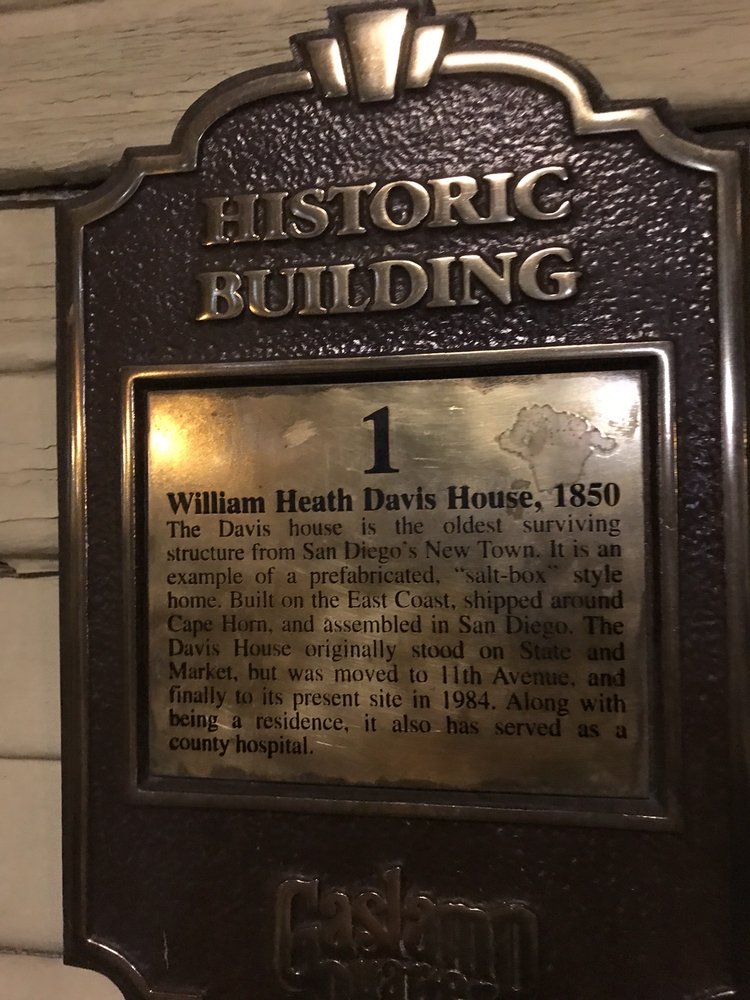
What you’re looking at. The oldest surviving building in downtown San Diego, a pre-cut saltbox house shipped from Portland, Maine, around Cape Horn in 1850, because there was no lumber mill in San Diego worth the name. It’s been a military barracks, a county hospital, and Alonzo Horton’s own home before it became the Gaslamp Museum.
The story. July 1917. The war has finally reached America, and it reaches this house too: a German national named Karl Offer is taken into custody here, an alien enemy under wartime law. That’s the whole of what the record gives us: a name, a month, a charge.
What grew up around that arrest is where the story gets its legs, and tour guides in this town have told it the same way for decades: that Offer wasn’t only a resident but a lookout, watching the U.S. Pacific Fleet from this house’s attic window as it rode at anchor in the bay below, and that he’s kept the watch ever since. His apparition, guests are told, still paces those same boards, dressed, in some tellings, for a war that hadn’t even started when his uniform is supposed to date from.
It’s the single most-told ghost story in the Gaslamp Quarter, repeated by nearly every operator working these streets, and it’s earned that reputation the honest way: it’s a genuinely good story, well told, for a long time, by a lot of different people.
It’s the single most-told ghost story in the Gaslamp Quarter, and it’s earned that reputation the honest way.
What people say happens here. Visitors and staff describe cold spots that arrive without a draft to explain them, a scent of lavender in rooms where nobody is wearing any, and a medicine chest, latched every night, found standing open by morning or swinging shut while someone’s hand is still an inch from the handle. More than one guest has caught, near the child’s room upstairs, the shape of a woman in Victorian dress, there and then gone. Museum staff who close up alone report the same short list of things, year after year.
The skeptic’s corner
Here’s the wrinkle: the arrest is real, but the spying, the fleet-watching and the ghost trace to nothing earlier than tour-industry telling, and the uniform guests describe is for the wrong war entirely, a plain anachronism for a man arrested in 1917. That kind of drift is what a story picks up by mouth, not proof nothing happened. People have kept this story alive in that attic for a century. We’ll let you decide what that’s worth.
2. The Oasis: The Morning the Stingaree Closed
What you’re looking at. A Fourth Avenue storefront. Nothing from 1912 survives here; the building in this story is gone.
The story. Eight o’clock on a Sunday morning, November 10th, 1912, and thirty San Diego patrolmen are already moving through the sixteen blocks south of here known as the Stingaree. Word got there before they did: messenger boys ran the warning through these streets hours earlier, and almost nobody bothered to run. By the time the wagon pulls up outside the Oasis, a resort at 416 Fourth Street, whatever’s about to happen already feels like a formality to the women waiting inside.
They step into the wagon, as the paper will print the next morning, “as demurely as if they were doing the most commonplace thing in the world,” laughing on the way to the station. A crowd has gathered to watch. It goes home disappointed: no fight, no spectacle, nothing to justify the early start to the day.
At the station, 136 of the 138 women arrested that morning agree to leave the city, most bound for Los Angeles. One does not go quietly into that agreement. Her name is Flora West, twenty-eight years old, and she has something to say to the reporter standing in front of her. She tried the honest way once, she tells him: two thousand dollars saved, spent learning hairdressing, and then swindled by the very people teaching her the trade, turned out with nothing to show for it.
A crippled mother and a young sister are waiting on whatever she can send home, and no honest wage in this city covers what she owes. She watched a reform-committee woman walk past the wagon that morning, “holding her skirts away,” as if the air itself might be catching. When the offer of reform reaches Flora West directly, she gives it two words: “No, thank you.”
When the offer of reform reaches Flora West directly, she gives it two words: “No, thank you.”
The police chief, leaving the station that night, doesn’t sound like a man who thinks he’s won anything. Closing a district doesn’t end a trade, he tells the same reporter. It just moves it somewhere else. He’s right. Prostitution doesn’t leave San Diego. It leaves the Stingaree.
What people say happens here. No ghost story is attached to this address, and none of the operators working this block claim one. What carries forward, guide to guide and guest to guest, is Flora West’s own line, because it’s the part of the morning nobody has to invent: a woman offered a way out on someone else’s terms, who looked the offer in the eye and said no.
The skeptic’s corner
The one thing we couldn’t pin down is the Oasis itself: what it looked like, who ran it day to day, whether any trace of its walls survived the century since. The newspaper calls it only “a resort” and gives the street number; nothing more specific has turned up. That’s a gap in what got written down, not a reason to doubt that any of it happened. Everything else in this story, the date, the count, Flora West’s own words, comes from that same single article, and it has held up to every check we could run against it.
3. The Undertaker’s Row: Two Buildings, One Trade
What you’re looking at. Two buildings that shared San Diego’s funeral trade for twenty years: a furniture-and-coffin storefront and, next door, a purpose-built mortuary with a trap door cut into the floor to lower caskets straight into the basement.
The story. Walk this block face in the 1880s and you’re walking past the business of the dead, conducted in plain daylight. On one side, a furniture dealer sells coffins in the very same showroom where he sells chairs and tables, no separation between the two trades. Next door, in the purpose-built mortuary, a wooden trap door is cut into the first floor: a body goes down through the boards and into the basement below, out of sight of the street, while upstairs the undertaker’s own business partner and his wife go on living directly above the coffins, which is either grim or practical depending on how you feel about sleeping over your work.
The man running the trade is Edward Tebbutt, in business with a partner named John Gray. Every ghost tour working this block tells you Tebbutt shot himself inside the Montijo Building in 1903, and that his presence is the most reported thing on this stretch: a distressed male figure, a wave of sadness that settles into particular spots, sounds with no source anyone can find.
Here’s the twist the tours don’t usually mention. The county’s own coroner’s inquest, the actual legal record of Tebbutt’s death, gives his full name, his age, his trade, and the date: the 4th of June, 1894, nine years earlier than the story everybody tells. Even that document won’t settle which building he died behind, the Montijo or the one next door; the Gaslamp Foundation’s own historian, working from separate deeds and city records, places it at the neighbor instead.
The year the guides use is wrong by nearly a decade, plainly, and the exact door has been argued over by the people who research this block for a living. The man was real. The death was real. The story just picked up nine years somewhere along the way, the way stories told out loud tend to.
The man was real. The death was real. The story just picked up nine years somewhere along the way, the way stories told out loud tend to.
What people say happens here. Guests and guides describe the same handful of things at this stop: a heaviness that settles over certain visitors and passes just as suddenly, a shape glimpsed at the edge of a doorway, a name spoken aloud that nobody in the group said. It’s reported consistently enough, by enough different people over enough different years, that guides keep bringing groups back to the same spot to feel it for themselves.
The skeptic’s corner
Whether Tebbutt, or something of him, is still on this block isn’t a question a coroner’s inquest was ever going to answer, and we’re not going to pretend it can. Records from 1894 often didn’t bother specifying which of two neighboring buildings a death happened in, especially when both belonged to the same trade, which may be exactly why even the county’s own paperwork stays quiet on the point. What we can tell you is that people have been reporting the same feeling here for a long time, at a spot where a real man really died, however the paperwork and the story disagree on when. We’ll leave the rest to you.
4. Prohibition Lounge: The Trap Door on Fifth Avenue
What you’re looking at. A basement bar at 548 Fifth Avenue, a few steps below the sidewalk, one block down from the undertaker’s row you just left.
The story. Go down the stairs and you’re standing where the bodies came in.
Go down the stairs and you’re standing where the bodies came in.
By 1885, this block face belongs to the death trade too. The same John Gray and Edward Tebbutt from the undertaker’s row run a coffin business somewhere along here, and they’ve solved the same problem every undertaker on a busy street has to solve: how to bring the dead in without carrying them past the living. Their answer is a second wooden trap door, cut into these floorboards. A body goes down through the boards, out of sight of Fifth Avenue, into the cool dark underneath. The ceiling over your head is roughly where that door sat, though not even the record agrees on that much: the source that documented this trade and the Gaslamp Foundation’s own staff historian, working independently, have never settled whether it ran out of this building or the one next door. Neither will pick.
There’s a second name attached to this stretch of Fifth Avenue, and it belongs to a much bigger story than a trap door. Wyatt Earp really did spend time in San Diego in the 1880s, and that part isn’t legend, it’s documented: the Gaslamp Quarter’s own historical association keeps a dedicated page on his actual San Diego business dealings, built on a named biography and a 1928 oral history, and it places him a few blocks from here, running the Oyster Bar out of the Louis Bank of Commerce. Whether he ever set foot in this particular basement is a different question, and a much shakier one, the kind you’ll hear anyway before the night’s over.
There’s a second address that carries his name through these same streets. Two blocks over, at Sixth and Market, the Tivoli Bar and Grill has spent decades billed as the oldest bar in San Diego, and it has earned that title without any two tellings of its own founding agreeing on the facts. One account puts a saloon on this corner in 1885. Another calls the building the Walker House first, sold on to a pair of Italian immigrant brothers who renamed it the Tivoli in 1915. A third traces the place all the way back to 1864 and credits Alonzo Horton himself as founder, a full three years before Horton had bought so much as a single lot of the New Town he’d go on to build, which makes that version impossible on its face no matter how often it gets repeated. What every telling agrees on is the bar itself: a hand-carved back bar, the story goes, built in Boston and shipped around Cape Horn to get here, standing behind the same cash register and safe still in use at the counter today. And the name that echoes down the block from this trap door echoes there too. Earp, more than one source says, drank at that bar as well as at his own Oyster Bar a few streets over.
What came after both stories is the part the tours have told for decades. They will tell you this basement stayed in the business of the dead for more than a hundred years, that it served as San Diego’s morgue while the city grew up over the top of it, and that a room doesn’t hold that much of anything without keeping some of it.
What people say happens here. Lights flicker down here with nothing wrong upstairs. People describe the feeling of being brushed past in a room where nobody is walking. Staff who’ve worked whole shifts in this basement and staff who won’t go down alone work the same bar, on the same nights, and the reports are consistent enough across years and across owners that something is going on, whatever it is.
The skeptic’s corner
Three different things don’t hold up here, and they get different treatment. On Earp at this basement: no deed or directory names him as an owner or even a regular of this specific building, only a neighboring museum’s own promotional history, and the one authoritative source on his actual San Diego dealings doesn’t mention this address at all. That’s a plain gap, not a maybe. On the morgue: the “over a hundred years” claim doesn’t appear in any document we could find, including the ones that keep repeating it, and this address isn’t in the city’s own historical landmark register at all. San Diego’s early records are full of holes, though, and a working undertaker’s basement is exactly the sort of thing nobody filed paperwork about. On the Tivoli: the same authoritative Earp source that stays quiet on this basement also stays quiet on that bar, naming only the Oyster Bar; the Tivoli claim traces to blogs and bar roundups repeating each other, not to anything new. Its own 1864-founding version fares worse than a gap, since Horton hadn’t yet bought the land it stands on, which makes that one telling flatly wrong rather than merely unproven. People have been telling all three parts of this story down here for a long time, and enough of them have felt something to keep telling it. We’ll leave that one to you.
5. The Casino Theatre: The Ad That Beat the Caption
What you’re looking at. A working ice cream shop under a movie marquee that’s original to the building.
The story. Two p.m., July 4th, 1912. The marquee above you is new, the paint barely dry, and the Casino Theatre is opening its doors for the first time, exactly as its owners promised in their own paid advertisement that morning: “Casino Theatre Opens Today.” Independence Day crowds already fill Fifth Avenue, and this is where a good number of them are headed.
The building went up fast, to a brand-new fire-safety ordinance the city adopted only months earlier: five feet of open passage on both sides and across the back, in case the worst happens on a packed holiday afternoon. Construction started in March. Hitting an opening date this close to schedule is its own small miracle for a downtown theatre in 1912.
Here’s what nobody in that crowd could have known: a single photo caption, typed decades later by the City’s own archive on an old picture of this block, would get the year wrong by one, calling it 1913 instead of 1912. Every source since, Wikipedia included, copied the caption instead of the ad these owners paid good money to run. Nobody lied. One caption just outran the truth for over a century, and outlived everyone who could have corrected it.
Nobody lied. One caption just outran the truth for over a century, and outlived everyone who could have corrected it.
Within two years, the theatre’s owners rented out the very side passages the ordinance had required them to keep empty, turning them into a restaurant and a shoeshine stand. The law demanded open space for safety. They saw two more storefronts. By the 1970s the building ran under the name Pussycat Theatres, showing adult films, still under the same marquee overhead. Today it’s ice cream.
What people say happens here. There’s one more thing you’ll hear about this building from somebody in town tonight, if you haven’t already: that a projectionist died here sometime in the 1980s. One version tells it as a fight that turned fatal. Another tells it as a fire, the man trapped inside. Staff and regulars who repeat the story don’t agree with each other on which one it was, only that something happened, and that it’s worth telling.
The skeptic’s corner
We found no newspaper account, no death record, and no name behind either version of the projectionist story. A fire or a fatal fight in a theatre operating nightly downtown is exactly the kind of thing that tends to make the paper, and neither did. Two different endings for the same man is what a story looks like after enough retellings, or what two real memories look like when nobody wrote either one down. Take it however you like; people keep telling it either way.
6. The Grand Pacific Hotel: Hotel, Mission, Hotel
What you’re looking at. The only Victorian-era hotel from the Gaslamp’s first building boom still standing on the ground it was built on, in 1887.
The story. Two men build this hotel in 1887: an attorney named Frank Jennings and a physician named George Crippen, who said at the time they wanted a building that would add to the appearance of that part of the city. For its first years, it runs as exactly that, a straightforward hotel.
Then, in 1901, someone sick or hurt arrives at this door, and the superintendent inside doesn’t ask questions first. Send her every sick or injured person seeking relief, no exceptions, the standing order reads, and this hotel becomes the Helping Hand Mission on the strength of it. By 1907 it’s a hotel again, though the floor that housed children stays in children’s use.
Here’s what you’ll hear from operators working this block tonight, and it’s a story worth hearing in full. Somewhere in those turn-of-the-century years, they say, this building lived a double life: a rescue mission by charter and a brothel by practice, the two trades running close enough together that a woman might pass between them without changing buildings. And that children’s floor upstairs is said to have grown into something bigger: San Diego’s own Children’s Memorial Hospital, born right here before it ever had a building of its own. Hotel, mission, brothel, hospital, hotel again, all inside twenty years, all in the same three stories. It’s the kind of history that sounds too tidy to be an accident and too strange to be invented.
Hotel, mission, brothel, hospital, hotel again, all inside twenty years, all in the same three stories.
What people say happens here. Guests and staff describe the ordinary catalogue of an old hotel with a long memory: doors that open or close with nobody near them, footsteps on floors that should be empty, the sense of being watched from a room that turns out to have no one in it. Nothing here points at a specific person or a specific year. It’s the kind of thing reported at enough old buildings that it’s hard to know what to make of any single one of them, including this one.
The skeptic’s corner
The brothel claim doesn’t hold up: we went looking for the paper behind it, a newspaper item, a court record, a directory listing, and found only the same sentence copied across sites that cite each other or nothing at all. The hospital claim doesn’t just lack support, it’s directly contradicted: Rady Children’s Hospital’s own published history dates its actual founding to 1954, in Kearny Mesa, with no downtown predecessor mentioned anywhere. Records from this era are thin generally, though, and a mission working with vulnerable women drew silence as often as scandal. The story’s been told long enough that we think it’s worth hearing anyway.
7. The Brunswig Building: A Date That Isn’t Its Own
What you’re looking at. A wine bar today, with 1888 carved into the stone above the door. That number belongs to a different building entirely, and a different city.
The story. This building wasn’t finished until December 1900. A man named B.A. Arnold bought the lot the year before and started digging the basement for a drug wholesaler, then died suddenly before a single brick went up. His widow had no interest in running a chemical supply business, so she sold what he’d dug to a druggist named Frederick Braun, who finished the job on Arnold’s foundation. Braun’s company grew into the largest wholesale drug house on the entire Pacific Coast. In 1908 he sold it to his own vice president, a man named Lucien Brunswig, whose name is the one still on the door, and on the wine bar in the basement today.
So where does the 1888 carved above the door come from? Not this building. That’s the year Braun’s original company was founded, back in Los Angeles, and when a third story went up here in 1925, someone carved the company’s birth year into the new facade instead of the building’s own. It’s been quietly misdating this address for a century.
Step up to that counter in this building’s early years and the transaction in front of you is entirely legal and entirely a judgment call: a teenage clerk, not yet licensed, looks a customer over, decides whether they seem, in the phrase of the day, “a rational sort,” and sells them carbolic acid or laudanum on that reading alone. No prescription, no second opinion, just a boy’s read on a stranger’s face. By 1970, the wine shop that replaced this pharmacy keeps its door locked during business hours, buzzing customers in one at a time after the same kind of look through the window. Different century, same doorway, same call, made a lot faster.
No prescription, no second opinion, just a boy’s read on a stranger’s face.
What people say happens here. No haunting is attached to this address, and none of the operators working this block claim one. What people do notice, standing at the door, is the doorway itself: original to the building, narrow enough that the old buzzer-and-window system would have worked from exactly this spot, a hundred years of the same judgment call happening in the same three feet of space.
The skeptic’s corner
One more loose thread, small but real: even the building’s own street number is disputed. One historical account gives 363 Fifth Avenue; another respected source gives 383, for the same building, same date, same story. Nobody has resolved it either way. Stand in front of it tonight and you can read the number off the door yourself, which is more than the record has managed.
8. The Douglas Hotel and the Creole Palace: The Corner That Had to Be the Center
What you’re looking at. A bronze plaque set into the sidewalk, two blocks west of the Quarter’s own boundary and worth the five-minute walk. The building itself came down in 1985.
The story. It’s a Thursday night, Kitchen Mechanics’ Night, and the maids who worked this hotel all week have the evening off and the door for free. Downstairs in the Creole Palace, tables are filling for the best night of the week, by every account, because tonight belongs to them.
Any other night, a mostly white crowd from downtown pays a higher cover for the floor show, but the room runs the same either way: two shows, eleven and one, twenty-five cents at the door on standard nights, a house band tight enough that a teenage saxophonist named Harold Land walked in straight out of high school and got his start on this stage. The names that play this room over the years read like a history of American music: Bessie Smith, Billie Holiday, Duke Ellington, Count Basie, Louis Armstrong, Nat King Cole, because downtown’s hotels turn away Black travelers and the Douglas doesn’t, and the Creole Palace runs on the Cotton Club’s own model with one deliberate difference: no whites-only door, not here, not ever.
…the Creole Palace runs on the Cotton Club’s own model with one deliberate difference: no whites-only door, not here, not ever.
Upstairs, the hotel’s co-manager, known to everyone as Miss Mabel, keeps her poodle at her side while she runs the place. Her partner George Ramsey gives so much to the community that when he dies in 1963, the San Diego Union’s own obituary calls him the “Mayor of San Diego’s Harlem.”
What eventually closes the Douglas isn’t scandal. It’s the Civil Rights movement doing its job: once Black San Diegans can eat, sleep and be entertained anywhere in the city, the reason the Douglas exists quietly disappears. The building comes down in 1985. A neighborhood planning group is, as of this year, drafting a request to the city for a formal district to mark what this corner actually was.
What people say happens here. Nobody tells a ghost story about this corner, and that’s worth saying plainly rather than papering over. What people do carry forward is memory: descendants of the maids who got Thursday nights off still tell the stories their grandmothers told them, and the push for a formal historic district this year is itself a kind of haunting, in the best sense, a corner that refuses to be forgotten even with the building gone.
The skeptic’s corner
One detail rests on a single account, not yet checked against a second: that Miss Mabel also ran a separate operation nearby called Leroy’s Room, apart from the hotel itself. It comes from the same source that gives us most of what we know about this place in detail, which makes it neither more nor less trustworthy than everything else here that traces to one good account, in a place where a lot of what actually happened was never written down at all.
9. The Horton Grand Hotel: A Hotel Built From Two Others
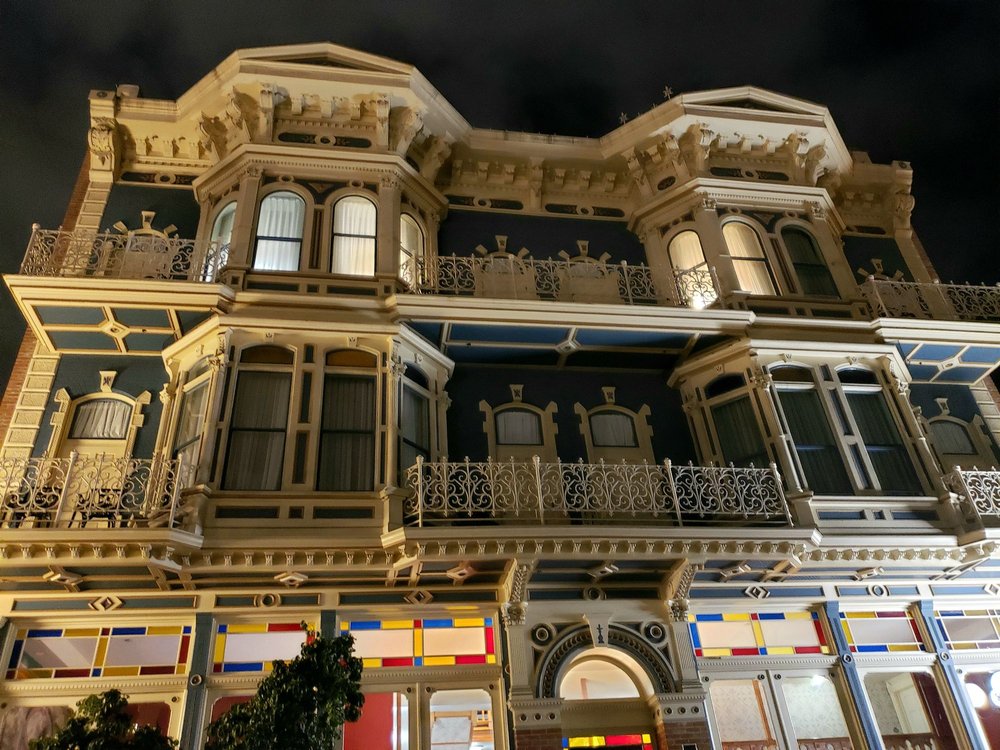
What you’re looking at. A hotel built from roughly eighty thousand individually numbered bricks, salvaged from two condemned 1887 buildings and rebuilt here, fused into one, in 1986.
The story. Every one of these bricks is real, old and original. Not one of them was originally laid on this spot.
Every one of these bricks is real, old and original. Not one of them was originally laid on this spot.
What stands here now used to be two separate hotels: the Grand Horton, built in 1887 across town near where Horton Plaza stands today, and the Brooklyn-Kahle Saddlery Hotel, a rougher, more Western building that stood in the heart of the old Stingaree red-light district, the same sixteen blocks emptied out by the 1912 raid you heard about earlier tonight. Both were slated for the wrecking ball in the 1970s. Instead, someone numbered roughly eighty thousand individual bricks, dismantled both buildings down to their foundations, and stored the pieces in a warehouse for years until a plan came together to rebuild them here, fused into one hotel, in 1986. Whatever stood on this exact patch of ground before that year, it wasn’t a hotel at all.
Now, the story you’ll hear about Room 309. A gambler named Roger Whitaker got caught cheating at cards, couldn’t cover what he owed, and was shot dead hiding inside the room’s wardrobe. It’s the single best-known ghost story in the entire Gaslamp Quarter, and the hotel itself is happy to tell it to you, brick by original brick.
What people say happens here. Guests report the bed shaking, the lights flickering, the smell of cigar smoke with nobody smoking in the room, and more than one has asked staff, halfway through the night, whether anyone else is supposed to be in there with them. The reports come from different guests, different years, different reasons for booking the room at all, and staff say it books up faster, not slower, once people learn why. Some ask for it by number without being told which room the story belongs to.
The skeptic’s corner
Whitaker is supposed to have died in the original building, before it ever came apart and got rebuilt here, which makes Room 309, as a physical space, no older than 1986. No record of a man by that name has turned up in San Diego, full stop, though county records from the 1880s are spotty enough that a man who died over a card debt wasn’t always the sort whose name made it into print. Younger room, older story. We’re leaving it exactly that.
Frequently asked questions
Is the Gaslamp Quarter actually haunted? Several of its most-told ghost stories, including the Davis-Horton House and Horton Grand hauntings, trace back only to tour-company retellings with no newspaper, inquest, or court record behind them. That doesn’t make them untrue. It means they’re folklore, told honestly as folklore on this page, and folklore has kept plenty of true things alive too.
What’s the most documented ghost story in the Gaslamp Quarter? Flora West’s own quoted statement to the San Diego Union the morning after the 1912 Stingaree raid is the strongest single piece of evidence behind any stop on this page: a named woman’s real words, printed the next day, not a retelling.
Why do different sources give different dates for the same building? Because most Gaslamp building histories trace to one unfootnoted local account, repeated and occasionally miscopied for decades. The Casino Theatre’s 1912-versus-1913 dispute and the Undertaker’s Row death date are both cases where a document and a legend disagree, and we’ve told you which is which.
Is Room 309 at the Horton Grand really haunted? The hotel itself tells the story, and no record of the man at the center of it has been found. What is documented is that the room’s physical location postdates the story by about a century, since the hotel was reconstructed brick by brick in 1986. Whether that settles anything is up to you.
Where does the Stingaree district’s story fit into the Gaslamp Quarter’s history? The Stingaree was the sixteen blocks south of today’s Gaslamp Quarter, closed by a single 1912 police raid described in detail above. Its ghost stories are largely undocumented; its real history, in the era’s own newspapers, is not.
Walking these blocks yourself is the best way to hear where the record and the legend split, and decide for yourself which parts you believe. The Haunted San Diego Gaslamp Ghost Tour covers several of these stops after dark, told by a guide who’ll name the source for you on the spot.
Exploring other neighborhoods? Old Town has its own nine-stop walk, from the Whaley House to Heritage Park: Old Town Ghost Stories: The Real History Behind San Diego’s Original Neighborhood. La Jolla isn’t a stop on our tours, but its coastline carries its own sourced history: La Jolla History and Ghost Stories. Balboa Park, Coronado, Downtown, the Embarcadero, Hillcrest and Bankers Hill, Little Italy, Mission Hills, Mission Valley, North Park and Golden Hill, and Point Loma each have their own guides too: Balboa Park, Coronado, Downtown, the Embarcadero, Hillcrest and Bankers Hill, Little Italy, Mission Hills, Mission Valley, North Park and Golden Hill, and Point Loma.
Keep Exploring San Diego’s Haunted History
Take the stories off the screen with our Gaslamp and Old Town Haunted Ghost Tour. Then follow the history north to Old Town Ghost Stories or west along the coast to La Jolla History and Ghost Stories.
Sources
- San Diego Union and Daily Bee, 11 November 1912, “138 Women Are Arrested in Stingaree Raid: 136 Promise To Leave City; Two Agree to Reform.” California Digital Newspaper Collection:
cdnc.ucr.edu/?a=d&d=SDDU19121111.2.94. - San Diego Genealogical Society, Coroner’s Inquests of San Diego County 1870-1896, Case No. 375 (Edward Wall Tebbutt):
cagenweb.org/sandiego/deaths_coroner_inquests_san_diego_county_1870-1896.pdf. - Gaslamp Quarter Historical Foundation, building histories by staff historian Sandee Wilhoit, for the Montijo Building, the Marin Hotel, and the Brunswig Drug Company Building, read via Wayback Machine capture.
- Thomas Lux, “The Plain Old Grim and Gruesome,” San Diego Reader, 29 January 1998:
sandiegoreader.com/news/1998/jan/29/cover-the-plain-old-grim-and-gruesome/. - San Diego Union and Daily Bee, 23 March 1912 (“Work Is Begun on Theatre”) and 4 July 1912, p. 9 (“Casino Theatre Opens Today”), California Digital Newspaper Collection.
- GenealogyBank, phrase search “Casino Theatre,” San Diego Union and Evening Tribune, 1912-1914.
- City of San Diego Digital Archives, photo caption, “Foxy and Casino Theatres Circa 1970,” the origin point of the 1913 date that Wikipedia and other sources copied afterward.
- Wikipedia, “Grand Pacific Hotel (San Diego)”: source of the 1887 construction, builders Frank Jennings and George Crippen, the 1901 Helping Hand Mission, and the 1907 return to hotel use. The Gaslamp Quarter Historical Foundation’s own page on this building, which Wikipedia’s account appears to draw from, returned an access error when checked directly and could not be read at the source. Rady Children’s Health, official history page, for the hospital’s own founding date and location (1954, Kearny Mesa).
- National Register of Historic Places, ref. 80000842, Grand-Horton Hotel, listed 20 June 1980; Horton Grand Hotel’s own published history (hortongrand.com).
- Elizabeth C. MacPhail, “Shady Ladies in the Stingaree District: When the Red Lights Went Out in San Diego,” Journal of San Diego History, Spring 1974, Vol. 20 No. 2, built on the unpublished memoirs of Walter Bellon, San Diego’s City Health Inspector.
- “The Douglas Hotel: the Harlem of the West,” San Diego Reader, 5 August 1999, excerpting Michael Austin’s thesis “Harlem of the West: The Douglas Hotel & Creole Palace Nite Club”; Cassandra Boydston, “The Creole Palace, San Diego, California (1924-1946),” BlackPast; BlackPast, “Ramsey, George (1889-1963).”
- Published pages of several national and local ghost tour operators, consulted for the folklore and rumor claims identified as such throughout this page (including the Casino Theatre projectionist story and the Karl Offer spy legend). Named as a category rather than individually, and not treated as documentary sources.
- Gaslamp Quarter Association, “Wyatt Earp” (
gaslamp.org/wyatt-earp/), citing Kenneth Cilch’s Wyatt Earp: The Missing Years and a 1928 oral history. The authoritative regional source on Earp’s actual San Diego business dealings; names his Oyster Bar at the Louis Bank of Commerce specifically and does not mention the Prohibition Lounge building at all. - Museum of Death, “Museum of Death History” (museumofdeath.net): the sole source located for the claim that Wyatt Earp owned the Prohibition Lounge building specifically, made in the museum’s own promotional history with no deed or directory behind it.
- 988 Suicide and Crisis Lifeline, available by call or text, any hour.
- Vanguard Culture, “The Buzz: 20 Oldest Watering Holes in San Diego” (
vanguardculture.com/the-buzz-20-oldest-watering-holes-in-san-diego/): source of the 1864 Horton founding claim, the Walker House name, the 1915 Tivoli renaming, and the Della Maggiora brothers. Cites no primary record for any of it. - Wikipedia, “Tivoli Bar and Grill”: its own citation list is three 2014 San Diego nightlife roundups (Sauer, San Diego Union-Tribune; Maher, Eater San Diego; Holtz, Thrillist), none of which cite a primary record for the 1885 opening date.
- “San Diego’s Oldest Saloon Once Owned by Old West Legend,” inpicsandwords.wordpress.com, 12 February 2022: the source for the Wyatt Earp-at-the-Tivoli claim, alongside the Museum of Death and ghost-tour-operator sources named above. A personal blog citing unspecified oral histories and hotel promotional material.
Take the tour
- Haunted San Diego Ghost Bus
- Gaslamp and Old Town Haunted Ghost Tour
- Paranormal Investigation History Tour
- Private Group Tours