

Little Italy has no ghost stories. Not one. Every stop on this walk was checked twice for a paranormal claim and came back empty both times, and a live sweep of San Diego’s major ghost-tour operators found their haunted inventories built almost entirely on the Gaslamp Quarter, with nothing at all on these six blocks. What Little Italy has instead is paperwork: three homemade bombs found under a house in 1908, five fishermen jailed over roosters in 1916, and four thousand gallons of wine seized from eight houses in a single afternoon in 1930, with an organized crime family’s name printed on the charge sheet.
This page walks Kettner, India and Columbia Streets from the Waterfront Bar at Grape north to the old cannery corner at Juniper, and at every stop it tells you what the document says, what the family says, and where those two things part company. Two of the thirteen stops sit a block or two outside the neighborhood’s own historic boundary, included anyway because that is where the best paper turned out to be.
A plain note before the walk. Little Italy is not currently a stop on any Haunted San Diego Ghost Tours route. No host stands here after dark as part of what we run nightly through the Gaslamp Quarter and Old Town. This page is a sourced guide to the neighborhood, researched from newspapers, archives and named sources, and told just as honestly.
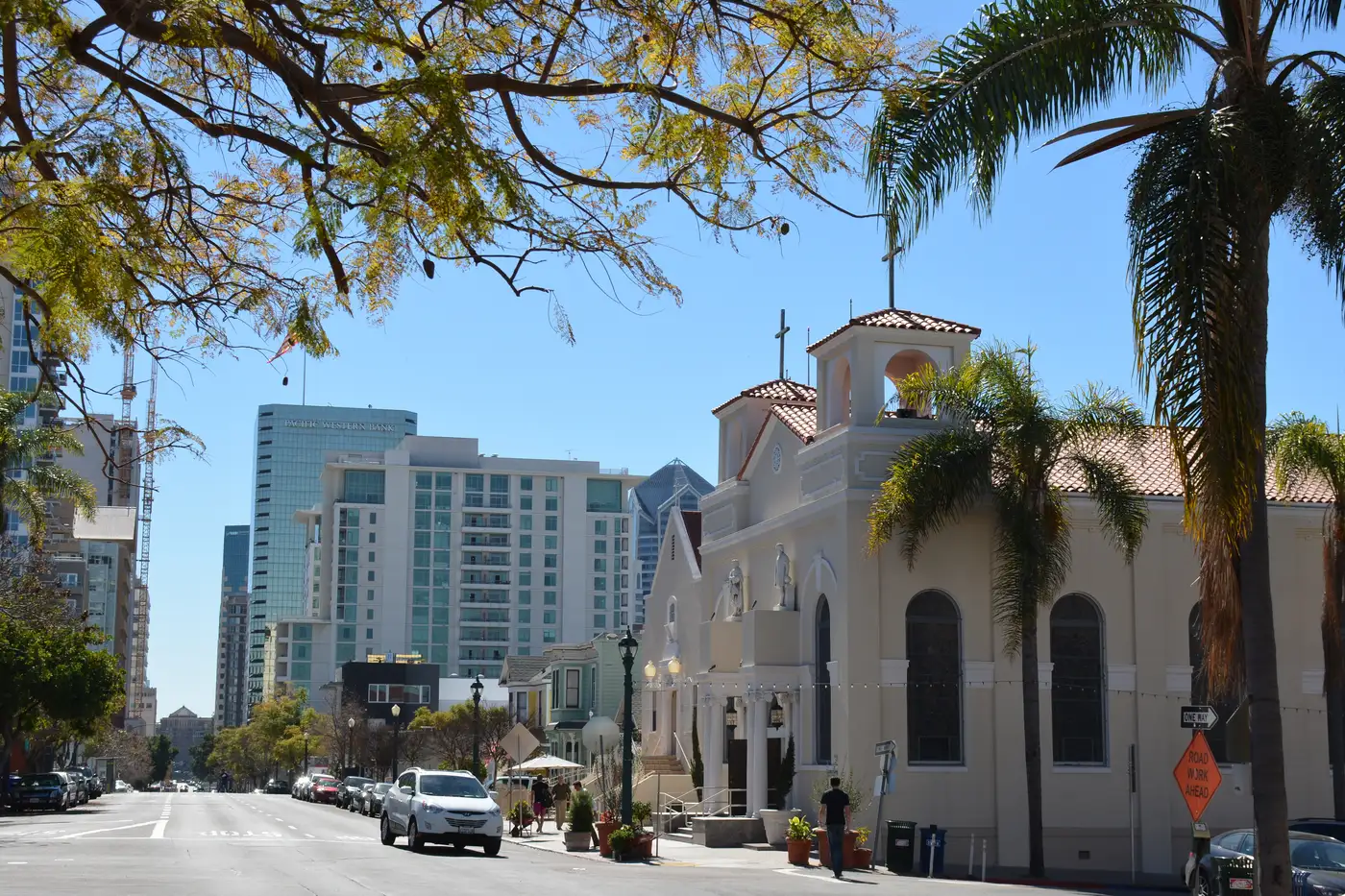
“Little Italy, San Diego, CA 92101, USA – panoramio (8)” by Roman Eugeniusz, CC BY-SA 3.0, via Wikimedia Commons.
Thirteen stops from the waterfront to the cannery corner
The walk below starts at the Waterfront Bar and Grill at Kettner and Grape, moves north through the blocks where eight houses were raided for wine in December 1930, circles the piazza and the bronze plaque trail on India Street, and ends at the old Del Monte cannery corner where the shoreline used to run. Where the record and a family’s own memory disagree, both are told, and the copy says which is which.
1. The Waterfront Bar and Grill: Open on the Day Prohibition Ended
What you’re looking at. A corner bar at Kettner and Grape that has served this waterfront for more than ninety years, and still sits in the same family.
The story. It opened on the fifth of December, 1933. Not near that date. On it. That is the day Prohibition ended in the United States, and this room was already pouring. It was founded by a man named Clair John Blakley with a silent partner, Chaffee Grant, reported to be a grandson of President Ulysses S. Grant, and the silence was the point: in 1933 you did not hang that particular family name over a bar door. Blakley’s wife Gladys ran the kitchen. Her sister and brother in law came in to help and eventually bought the place outright, and a few decades later the current owner’s great grandfather bought it from them. For ninety odd years this corner has served tuna fishermen straight off the boats and longshoremen in the same room, at the same hours, as businessmen, lawyers and judges. The current owner told the San Diego Reader in 2011 that some of the regulars have their own keys: “If the morning girl is late, they’ll open up for her.”
What’s actually true. Nearly every write up you will find calls this the oldest tavern in San Diego, and the narrower version is better. There is a bar in the East Village, the Tivoli, that opened in 1885 as the Tuscan House, run by two Italian immigrants. That is forty eight years older. Here is the part that gives the whole thing away: the people who own the Waterfront are not the ones saying oldest. Their own wording is that this was “one of the first bars in San Diego to be issued a legal post-Prohibition liquor license.” One of the first. That is a careful sentence written by people who know exactly what they can defend, and the folklore has been quietly upgrading it for them ever since.
There is also a rumor that floats around this address, that it holds California liquor license number one. We went looking for that specifically. It is not on the bar’s own site, not in the Reader, not in any local history blog covering it. Nobody is making that claim, including the people who would benefit most from making it. We are not saying it is false. We are saying we could not find anybody willing to be the one who said it.
2. Three Bombs Under a House on India Street, 1908
What you’re looking at. A rebuilt block near the southern edge of the neighborhood, south of Ash Street and technically outside today’s Little Italy line, in a stretch this project treats as part of Downtown’s own history rather than Little Italy’s. It stays on this walk because it is the most rigorously sourced thing in the entire corpus: a newspaper page read at first hand, not quoted through somebody else’s retelling.
The story. Fifteen people were living in a one storey frame house on this block in the summer of 1908. Under the floor, where nobody had looked, were three homemade bombs.
A Mexican woman named Julia Bustamante found them while sweeping out under the back porch. She did not know what they were. She looked them over, set them down, and started sweeping them toward a fire she had just lit to burn rubbish. A small boy who also lived in the house saw the fuses, understood immediately what he was looking at, ran over, picked them up and told the women. That drew a crowd, including the landlady, a Black woman named Sarah Bennington, who took the bombs into her own room and called the police. An officer wrapped them in newspaper and carried them back to the station.
Here is what the San Diego Union and Daily Bee did with it the next morning, in the headline, before a single arrest had been made: “BOMBS DISCOVERED UNDER HOUSE ON INDIA STREET ARE BAFFLING TO POLICE. Theory of Mafia or Black Hand Not Discredited.”
Read that second line again. Theory of Mafia or Black Hand not discredited. That is not a finding. It is a double negative doing the work of an accusation, printed directly above three people who had just done something genuinely brave: a woman who nearly swept live explosives into a fire, a boy who recognized a fuse and moved fast, and a landlady who took the risk into her own hands rather than leaving it lying on the ground.
What’s actually true. The paper’s theory was that the bombs had been meant for an Italian family who had moved out of the house about four months earlier. Nobody had been arrested. Nobody had been identified. What the paper actually had was an empty house, a former tenant, and a word. This page is not going to correct the 1908 Union, and it is not going to adopt its theory either. Extortion bombings against Italian families were a real phenomenon in this era, and this same street saw at least one, documented, twenty six years later. None of that is evidence about this particular house. The Union says Mafia or Black Hand. The rest of the article says three neighbors and a fire. Both sides are on the same page of the same newspaper, and we are leaving them there.
Whether anyone was ever arrested is a genuine blank. No follow up article has been found, and the archive is free and searchable well past 1908, so this is an open question rather than a closed one. If you are working this corner into a longer walk, the Downtown San Diego stops pick up the rest of that neighborhood’s own documented history.
3. The Clean Sweep of Little Italy, December 1930
What you’re looking at. The residential blocks running back off India toward Kettner. Eight houses were raided here on a Friday afternoon in December 1930, and we are not printing the street numbers, because nobody has checked which of those buildings are still standing and lived in.
The story. Police and federal agents took four thousand gallons of wine out of those eight houses. Sixty five barrels. It took a truck several trips. Eleven people were arrested, and the evening paper printed every one of their names and addresses, which is the only reason this story can be told at all. The San Diego Union headline the next morning: “SEIZE 4000 GALLONS WINE IN 8 RAIDS HERE; 11 HELD. CLEAN SWEEP OF ‘LITTLE ITALY’ BY POLICE AND FEDERAL DRY AGENTS.”
Notice the punctuation. The paper put Little Italy in quotation marks in 1930. The name was already in everyday use on these blocks, and the newspaper was still holding it at arm’s length like slang.
What survives alongside the arrest record is the neighborhood’s own memory of what that wine actually was, collected sixty six years later by a San Diego Reader journalist who found elderly residents willing to talk only if she used no names. The grapes were muscatel, trucked in from a winery out in Escondido. You could make wine for your own family legally, with a permit: “We went to the old post office, to the downstairs, and got a license for three barrels of wine.” A ton of grapes cost two hundred dollars and made about a hundred gallons, eighty after fermenting and evaporation, and that was a year’s supply. The kids worked it. “I used to help. I crushed the grapes with my feet.” When a barrel went over its limit it did not quietly leak. “Once in a while the barrel would blow up, ferment too much, it was a mess.” And when the police came they did not discreetly confiscate anything. “The policemen used to come and break the barrels and let the wine go out in the streets.” One older man, who also would not give his name, put the whole neighborhood into one sentence: “At night people would come down to Little Italy, dodging police, to buy wine.”
What’s actually true. Here is the detail that turns a wine raid into the start of something much larger. One of the charge sheets that ran in the paper that evening read: “Frank and Sam Bompensiero.” Frank Bompensiero went on to become one of the most consequential organized crime figures in San Diego’s history. In December 1930, as far as any document can prove, he was a man on this block with wine in his basement, one name on a list of eleven, arrested the same afternoon as everybody else.
A flag on the sourcing, because it matters. Every newspaper quotation in this stop comes at one remove: transcribed and quoted at length by a named 1996 journalist rather than read off the original 1930 page. A genealogical index confirms articles exist on those exact dates, which proves the articles are real and proves nothing about their exact wording. One page scan would close that gap. Nobody has pulled it.
4. Piazza della Famiglia: The Living Room That Won the City’s Worst-Design Award
What you’re looking at. You are standing in the middle of a street. Not beside one. In one. Until 2018 this was a block of Date Street with cars running through it, closed to traffic, repaved and handed back to the neighborhood as a public square.
The story. The Little Italy Association calls this the living room: the heart of the neighborhood, home to the farmers’ market, concerts, cultural events, the place everybody gathers. They put up a monument on the west side in 2021 carrying the piazza’s own origin story, topped with an embossed olive tree for family, strong roots, generations.
Here is the argument that nobody standing on this pavement knows is happening. In that same year, 2018, the San Diego Architectural Foundation, a nonprofit devoted to architecture and design education in this city, gave this exact space an Onion. That is the Foundation’s own annual award for the worst design in San Diego, and their review deserves to be heard in full rather than summarized: “Despite its name, Piazza Famiglia is not a piazza at all. A piazza is an urban space at the intersection of two or more roads, enclosed on three or four sides; Piazza Famiglia is a pedestrian street with tables and a fountain… If Italy had a nightmare, it would be Piazza Famiglia. The scale of the streetlights (on steroids), the maximum security prison lighting levels, the grotesque plastic fountain… If I were Italian I would sue the architect for misrepresentation of the homeland.”
What’s actually true. Two named San Diego institutions, on the record, about the same stretch of pavement you are standing on. Neither side is settled here and neither one is wrong to say what it said: the Association is describing what this space does for the neighborhood, and the Foundation is describing what it looks like while doing it. Pick whichever you like. We are not picking.
One more thing worth knowing while you are here. Nothing was demolished to build this piazza, but one small house did have to move. It belonged to the Giacalone family, and when construction broke ground in 2014 the developer picked it up and drove it two blocks east instead of tearing it down. It is still standing, and you will walk past it later on this page.
5. The House He Came Back to Every Morning
What you’re looking at. Nothing in particular, and that is deliberate. This stop stays at area level. Somewhere in these few blocks there was a house where an old woman in black lived with her daughter, and with whoever had just arrived from Sicily and needed somewhere to start. We are not telling you which one.
The story. Her name was Anna Maria Tagliavia Bompensiero, a fisherman’s widow with six children. Her own granddaughter described her to a reporter decades later: “A typical little peasant Sicilian lady. I never saw her wear a color in my life and she died at 92. No lipstick, no perfume, nothing. Ever. Once she became a widow, she wore black, for the rest of her life.” Small gold ball earrings, a bandanna tied like a kerchief, nothing else. She never remarried.
She was there for the founding of Our Lady of the Rosary in December 1925, and for almost fifty years afterward she knelt there most mornings and said a fisherman’s prayer in Italian: when the storms of life menace your fragile boat, look to the star, call on Mary.
And her eldest son, the head of the family, a man who became one of the most dangerous people in San Diego’s history, began nearly every one of his San Diego mornings for close to fifty years by letting himself into her house for a cup of coffee. Whatever he had done the night before, and by every account he had done a great deal, he came here first and sat down with his mother.
What’s actually true. That is the whole story, and it is deliberately not the story of what he did, which belongs somewhere else entirely. It rests on exactly one source: a 1999 San Diego Reader interview in which a named granddaughter talked about her own grandmother and her own father, for publication. Nothing in it is independently documented. Anna Maria Tagliavia Bompensiero has no record of her own outside that interview: no death certificate, no burial record, no census entry anyone has found. A family’s memory is real evidence, and it is a different kind of evidence than a document, and this stop is the former.
And the reason we are not naming the house: nobody has checked whether people live in it now, and this project does not send strangers to a stranger’s door on the strength of a seventy year old interview. That is not caution for its own sake. It is the same courtesy the family extended when they told the story in the first place. They told a reporter about their grandmother. They did not tell anybody about their address.
6. The Trapdoor Under the Fishing Nets
What you’re looking at. Again, nothing pinned. Two houses somewhere in this part of the neighborhood, neither confirmed demolished, both withheld for the same reason as the stop above.
The story. Somewhere in these blocks there was a fishing net, and under the net there was a trapdoor, and under the trapdoor was a basement full of wine. Policemen used to stop by and buy it by the shot. The woman who ran it could not read or write. She bought property anyway.
Her name was Felipa Sanfilippo, and her granddaughter told the whole thing to a reporter in 1999: “Underneath my grandfather Sanfilippo’s nets, there was a trapdoor. You’d open that trapdoor and go into the basement and that’s where my grandparents kept the wine. Policemen used to stop by, and they’d buy wine by the shot.” In 1923, when her daughter turned twelve, the girl learned to drive a Model T so she could take her grandmother out on deliveries. “My grandmother wore long skirts and my grandmother would have under her skirt, two jugs of wine.”
Sit with that image for a second. A twelve year old girl driving a Model T through these six blocks, an old woman riding beside her with two jugs of wine hidden under her skirt, working a route.
Who was Felipa Sanfilippo? Her granddaughter again: “I think she really was the boss of the tribe. She was a hard businesswoman… What she did is borrow money and buy property. She was a shrewd lady.” She owned three houses. Her husband was a fisherman with two or three boats. And the family remembered a line from her own banker: “The guy at Bank of America… said that had she been able to read and write and speak better English she would have been a multi-millionaire.”
What’s actually true. Now the part this page is not going to answer. That same granddaughter told the reporter that her grandmother introduced her own son in law to people in Los Angeles, specifically to a man named Tom Dragna, brother of the head of the Los Angeles crime family. “I don’t think my dad ever went back to fishing again,” she said. The reporter who first heard it spent a full paragraph declining to draw the obvious conclusion, and this page does the same, because the obvious conclusion is not what the evidence supports.
Label this one honestly: it is a rumor. We got it from one family member’s memory of what she was told by another relative, forty years after the fact, printed in a named newspaper by a named journalist. The question underneath it is a good one and nobody has answered it. How did an illiterate Sicilian woman in San Diego come to know the Dragnas, who were not from her home village? The family does not know. The journalist did not know. We do not know. It is a real claim, it is genuinely interesting, and it is exactly as solid as that description makes it sound.
7. The Roma Inn, Found
What you’re looking at. The 1700 block of India Street, right up against the hotel on the corner. The first research pass over this neighborhood called the Roma Inn the single most valuable thing it could not find: no address, no building, no record, nothing. It has been found since, and it was never where anybody was looking for it.
The story. Here is this block as two men who grew up on it remembered it, separately, to the same reporter, in 1996. On the corner, where a hotel stands today, was Bernardini’s, which belonged to one man’s uncle. Further along the same block, a second uncle ran a barbershop out of his own house. A third uncle had a shoe shop. Three uncles, three storefronts, one block.
A Neapolitan grocer named Antonio Mattera opened his first store on this block around 1926 or 1927. His son put it plainly, decades later: “Where the Roma Inn was, was his first store. My dad opened the first store about 1926-27, and then Prohibition ended and you could open bars and that’s when Roma Inn opened and took that store over.” When Prohibition ended, the family that had been running half a bar in the building next door built the Roma Inn straight into the shell of Mattera’s old grocery.
Four extended families, most of one city block. That is the real finding here, and it is not really a story about a bar. It is what a Sicilian block in San Diego looked like from the inside.
What’s actually true. The exact street number is still not established, and the two witnesses disagree with each other by one door. One account places things next door to 1753, another at 1747, and neither is 1753 itself. A single city directory entry for 1935 or 1940 would settle it outright, and it is the highest value document still missing from this whole neighborhood’s record.
Then there is the license claim. A relative of the family who ran the place told the same reporter: “The Roma Inn was about the second liquor license in San Diego after Prohibition. Tony Mirabile got the license for my aunt for the Roma Inn.” The man hedged it himself in the very next breath: “They gave so many licenses on the same day, so when you opened up was a matter of how fast you opened up your mail.” That is a rumor with its own teller attached and its own caveat already built in, and we are shipping it exactly the way he said it, hedge included.
Why the name matters: Tony Mirabile went on to become San Diego’s organized crime boss after his predecessor, Jack Dragna, died in 1956. In 1933 or 1934, that same man is the one a Sicilian family’s own memory credits with getting them a liquor license for a bar on India Street. That is the whole of his role in this particular story.
8. The Little Italy Sign, and the Mosaic Nobody Has Ever Described
What you’re looking at. The neon arch spanning India Street at West Date, the single most photographed object in the neighborhood. Look at the pillars: portholes. Look at the cables holding the whole thing up: rigging. It is built as a ship, because of what the families who settled here did for a living.
The story. It was switched on for the first time on the evening of the eighth of October, 2000, in front of a crowd at the seventh Little Italy Festa. Two sources agree on that date independently, the plaque’s own inscription and the Little Italy Association’s page for the sign, and that is worth pausing on because it is the opposite of everything else on this walk. The usual state of a modern landmark is that everybody remembers roughly when, and within twenty years the roughly is all that survives. Not this time. Two independent records agree down to the exact evening.
What’s actually true. And then it runs straight into something that cannot be closed at all. Both of those same sources describe the mosaic tile work set into the pavement on either side of the street in nearly identical wording: that it “tells how this immigrant community is historically tied to the bay, the church and the Italian homeland.” That is the entire description. In both sources. Nobody anywhere has written down what is actually pictured in those tiles. Boats? A church front? A map? Faces? Something else? If you are standing under it in daylight, you are looking at the only account of it that exists anywhere in writing.
One more note on how this got built. The plaque credits no single artist. It names a committee and a set of vendors: the Little Italy Design Committee, the Association board, and four named design and sign firms, funded by the city’s downtown redevelopment agency and a named councilman. No one person stands behind the most recognizable object in the neighborhood.
9. The Little Italy Legends, and the Bronze Man Who Was Never From Here
What you’re looking at. A six foot bronze man on the sidewalk outside a restaurant on India Street, at the southern end of a trail of bronze plaques running up the block.
The story. He sang “Rawhide.” He sang the theme to Blazing Saddles. Twenty one gold records. And he was never from this Little Italy at all. Frankie Laine, born Francesco Paolo LoVecchio to Sicilian immigrant parents from Monreale, was born in the Little Italy in Chicago, and when he came to San Diego in the early 1960s he settled in Point Loma and lived there the rest of his life. He never lived on this street.
So why is he standing here? Because he played cards with a restaurant owner named Joe Busalacchi for twenty two years, ate in the family’s restaurants, and once handed Joe his own gold record for “I Believe” as a birthday present. Joe has said Laine was like a father to him. The statue went up on the thirtieth of March, 2020, which would have been Laine’s one hundred and seventh birthday, and Joe unveiled it himself with Laine’s widow and his longtime producer standing there. A neighborhood that calls itself the other Little Italy honors a man from the one he was actually from, because of a friendship. Nobody tells you that walking past.
He is not alone out here either. Since around 2000, families in this neighborhood have been putting up their own bronze plaques along India Street. Not the city. Not a heritage foundation with a budget. Families, for their own people, under a banner reading Little Italy Legends. Each one carries a few hundred words about one immigrant couple: where they came from, what they did, how many children, what the business was. A man named Tony Bernardini, who came from Bari in 1907 and took a job maintaining tracks for San Diego’s streetcar line, which is the clearest thread this neighborhood has to that era of the city. A family married in Sicily in 1950, seven children, the husband fishing at first and then taking an airline job to be home more. A couple who met at a church dance in 1939 and reached their sixty fifth anniversary in 2007.
What’s actually true. They are still going up, and nobody has ever assembled them into a set. There is no map and no signage pointing from one to the next. The best account of them anywhere comes from a local photo blogger who came back three separate times across six years to find and transcribe them, and who kept finding new ones on each visit because more had appeared since the last. Our own count is known to be short. If you walk this block slowly you will almost certainly read a plaque that is not written down anywhere.
And one of them makes its own boast: that this was the only Little Italy in the entire United States to publicly celebrate the opening of the 2006 Torino Winter Olympics. Nobody has checked that against Boston, Chicago, Philadelphia or anywhere else. It is either a lovely fact or a lovely piece of civic pride getting ahead of itself. Either way it is the plaque saying it, not us.
If you want the version of San Diego where the ghost stories do have paper behind them, that walk is sixteen blocks south of here in the Gaslamp Quarter, which is where the whole industry’s inventory actually lives.
10. Amici Park, Furnished With Dinners Instead of Statues
What you’re looking at. A small park off West Date. Look down at the benches and tables.
The story. They have bronze dinners set into them. Plates, place settings, and stamped into the metal, the actual recipes of families who settled these six blocks. Not statues of anybody. Dinner. Every neighborhood memorial in America is a bronze person on a plinth. This one is not. Somebody decided the way to commemorate an immigrant fishing community was to cast its dinners, and it is a genuinely unusual civic decision that almost nobody notices, because furniture is invisible. The recipes are the memorial. The families are named on the food.
Now look at the small house at the edge of the park. It did not start here. It stood two blocks west on West Date Street and belonged to the Giacalone family, described by the organization that occupies it now as a prominent local fishing family. In 2014, when that ground was cleared for what is now Piazza della Famiglia, nobody tore it down. The Little Italy Association and the developer picked the house up and drove it here, whole, and it has stood at this corner ever since. It is now home to a nonprofit that preserves this neighborhood’s history through photographs, documents and oral histories.
What’s actually true. Nobody has been able to find out who made the bronzes. Every source describes them in the same terms and not one credits an artist, and the installation date is missing too. That is a gap in the record rather than a mystery about the art, and it is very likely answered by a plaque standing in this park right now, or by a City of San Diego public art record that nobody has pulled.
There is also a matched pair worth knowing. A couple of blocks north stands the oldest house in Little Italy, which survived a relocation plan back in 2008 that simply never happened; it stayed where it was. This house survived by going. Both are still standing, and neither outcome was the one anybody planned.
11. Mona Lisa Italian Foods, and the Street With Three Italian Shops on It
What you’re looking at. A deli and restaurant near the north end of India Street, third generation of the same family.
The story. The man who started it caught tuna for a living. That is not a colorful detail about him, that was the job, and this entire neighborhood was built by people who did it. Stefano Brunetto opened the first Mona Lisa downtown in 1956 with his brother in law and moved it to this spot on India Street in 1973.
Here is the line from the family’s own written history that almost nobody quotes, because it sounds like a small business bragging and it is not: “In 1973, we were one of only three retail Italian food businesses on India Street.”
Stand on India Street now and count the Italian storefronts you can see from one spot. Then hold onto this: in 1973, twenty five years after this became a neighborhood with a name, and six years after a freeway finished cutting a third of it away, there were three. The Little Italy people walk through today is younger than most of the people walking through it. That is not a story anyone tells you on this street. It is sitting in one restaurant’s own About page.
What’s actually true. That is a checkable claim, specific, naming its own two named competitors, both of which you can visit right now. Nobody has actually checked a 1973 city directory against it. If the count really is three, it is one of the strongest single facts in this neighborhood. If it turns out to be nine, that is an even better story, because it means a business has been quietly telling a shrunken version of its own street for fifty years. It is the entry’s best line and its thinnest citation: the business’s own account of its own competitive landscape half a century later.
There is one loose thread worth naming and not connecting: another shop further along India Street was founded by a woman whose nephew shares the Brunetto surname. A shared surname is not a family relationship, and nobody has traced whether these two founding families are related or whether it is coincidence.
12. The Roosters of India Street, 1916
What you’re looking at. The 2000 block of India, and the corner of Fir and what the 1916 paper called Arctic Street, now Kettner Boulevard.
The story. In September 1916, police arrested five Italian fishermen on this block. The charge was maintaining a nuisance. The nuisance was roosters.
The San Diego Union and Daily Bee ran the headline: “Roosters Crow as Bold Fishermen Brave Waves; Five Now Under Arrest. Italians Who Sail the Main Pained to Learn Noise of Barnyard Pet Violates Law.” The story underneath is small and complete. Five men who fished for a living kept chickens in their yards, the way everybody on this block kept something in their yards. The roosters crowed at the hour roosters do. And a woman on this same block had had enough.
Her name was Mrs. A. L. Anderson and she swore out the warrants herself. She told police she was determined to have a few moments of rest during the remaining years of her life. With, by her own count, ten or sixteen jubilant roosters going off around her, it was impossible to snatch more than a few hours of sleep the entire night. Ten or sixteen. She had counted, and she had stopped being sure of the number.
The five men were arrested. And here is the line that makes this a real story rather than a funny headline: none of the five could speak a word of English, and none of them had the least idea why they had been arrested until an interpreter explained it to them, and then put up the bail himself, out of his own pocket, for all five. The paper never gives his name.
What’s actually true. All of it, read directly off the 1916 page. What the page does not settle is the fine print underneath it. The paper called all five men Italian. But one of the surnames printed, Canepa, is Genoese rather than Sicilian, and another, Negrete, is not Italian at all, which quietly complicates the tidy version of this neighborhood as a purely Sicilian block. In 1916 the men keeping roosters on this stretch were Genoese, Sicilian and Mexican, and one newspaper rounded all five of them up under a single word, in the headline, the same way a different reporter rounded up a different set of neighbors eight years earlier, six blocks south of here.
The interpreter’s name is not in the record. Neither is what happened in court. The archive is free and searchable well past 1916 and nobody has chased either one.
13. The Cannery Whistle and the Beach That Used to Be Here
What you’re looking at. Juniper Street at Pacific Highway, formerly Atlantic Street, at the north end of the walk and just outside the neighborhood’s own boundary. Stand facing west. Everything in front of you is fill.
The story. A woman who grew up on this road remembered when the tide came right up to it, when there was a beach in front of her house and a skiff kept in the backyard in case the water came in. She was a Sanfilippo daughter, elderly when a reporter found her in the 1990s, and this is her own account: “My mother and I, we worked at the fish cannery, all hard work, getting up at two in the morning. When those little fishing boats go out for sardines and anchovies, they would blow the whistle and we had to be alert and hear that whistle blow so we could get up at midnight, two, four in the morning to go to the cannery. The Del Monte cannery was at Juniper and Atlantic. I was 11 years old. We would walk there.”
The work did not run on a clock. It ran on the boats. You went to bed listening for a sound, and whatever hour it came, you got up and walked.
Then the shoreline, from the same woman, describing the house she grew up in on this road: “Before they made the freeway, it was just dirt road and the bay. The tide goes out and comes in, it used to come up to Pacific Highway, that’s how close the water was. When I was a little girl we had a skiff in the backyard in case the tide would come in. We had two big palm trees in front of our house, a beach in front of our house.”
Everything west of where you are standing today is landfill. This is a first hand account of when it was water.
She remembered the neighborhood too, in the same interview: “When you walked by people’s houses, they would be sitting on their porch, you wave to say hello and people ask, ‘Where are you going?’ and they would say, ‘Come on over and have a cup of coffee.’… The doors were left open and no one stole anything.” Sicilian families lived up and down this stretch along India, Kettner, Date, Juniper and Union, in houses painted pink and blue, with brick ovens in the backyards where women baked bread for their own families and to sell as ship’s stores.
What’s actually true. This is the only first hand cannery labor testimony this project has found anywhere in San Diego, and it is also the thinnest kind of evidence on the page: one interview, one witness, one article. The cannery’s location and operating history rest entirely on one woman’s memory of a street corner. No corporate record for a Del Monte plant at this address has been located. Sanborn fire insurance maps for this stretch would very likely show it, and nobody has pulled them. Her family’s own house on this road stays unnamed here, for the same reason as the two stops above.
Frequently asked questions
Is Little Italy in San Diego haunted? There is no documented ghost story in Little Italy, and that is unusual enough to be the finding. Every stop on this walk was checked twice for a paranormal claim and came back empty, and a sweep of the major San Diego ghost tour operators’ published inventories found that their haunted San Diego content is built almost entirely on the Gaslamp Quarter, with nothing at all on these six blocks.
Why is it called Little Italy? Because Sicilian and Italian fishing families settled these blocks and worked the tuna fleet out of the bay. The name was in everyday local use by 1930 at the latest, which is when the San Diego Union printed it in a headline in quotation marks, treating it as neighborhood slang rather than as the place’s own name.
What happened to San Diego’s Little Italy? A freeway finished cutting away roughly a third of the neighborhood in 1967. By 1973, one longstanding family business counted only three retail Italian food businesses left on India Street, in its own written history. The Little Italy visitors walk through today is a later rebuild, not a survival.
Was there really organized crime in San Diego’s Little Italy? Two men connected to San Diego organized crime appear in documented records tied to these blocks: one was arrested in the December 1930 wine raid as one name among eleven, and one is credited in a family’s own memory with brokering a post Prohibition liquor license for a bar on India Street. Everything beyond that, including a 1908 newspaper’s Black Hand theory about three bombs, is theory or family recollection rather than proof.
What is Piazza della Famiglia? A block of Date Street closed to cars in 2018 and repaved as a public square. The Little Italy Association calls it the neighborhood’s living room. The San Diego Architectural Foundation gave it an Onion, its annual award for the worst design in San Diego, in the same year. Both statements are on the record and this page leaves them both standing.
Exploring other neighborhoods? The 1908 bombing on this walk sits just over Little Italy’s own southern line, in Downtown San Diego. The Gaslamp Quarter and Old Town are both stops on our nightly tours. Balboa Park, Coronado, the Embarcadero, Hillcrest and Bankers Hill, La Jolla, Mission Hills, Mission Valley, North Park and Golden Hill, and Point Loma each have their own guides too: Balboa Park, Coronado, the Embarcadero, Hillcrest and Bankers Hill, La Jolla, Mission Hills, Mission Valley, North Park and Golden Hill, and Point Loma.
Want a guide to walk you through the Gaslamp Quarter and Old Town after dark? Our Gaslamp and Old Town Haunted Ghost Tour covers both nightly, told by a host who will name the source for you on the spot.
Sources
- San Diego Union and Daily Bee, 17 July 1908, page 9, “Bombs Discovered Under House on India Street Are Baffling to Police.” California Digital Newspaper Collection:
cdnc.ucr.edu/?a=d&d=SDDU19080717.2.94. Full text read directly. - San Diego Union and Daily Bee, 22 September 1916, page 4, “Roosters Crow as Bold Fishermen Brave Waves; Five Now Under Arrest.” California Digital Newspaper Collection:
cdnc.ucr.edu/?a=d&d=SDDU19160922.2.42. Full text read directly. - San Diego Reader, “Mafia in San Diego before World War II,” 5 December 1996, by Judith Moore:
sandiegoreader.com/news/1996/dec/05/cover-dynamite-is-what-they-mostly-used/. Quotes the 5 and 6 December 1930 San Diego Union and Evening Tribune verbatim and at length; source of the anonymous winemaking testimony and of the Roma Inn block interviews. - San Diego Reader, “Why did Frank Bompensiero come to San Diego?”, 18 February 1999, by Judith Moore:
sandiegoreader.com/news/1999/feb/18/cover-bompensiero/. Single source for the Tagliavia Bompensiero, Sanfilippo and cannery testimony. - GenealogyBank, San Diego Union and Evening Tribune index, searched 18 August 2026. Confirms articles exist on 5 and 6 December 1930; index only, original text not read through this channel.
- San Diego Reader, “The Waterfront,” 6 July 2011:
sandiegoreader.com/news/2011/jul/06/deal-waterfront/. Source of the owner’s on record quotations. - Waterfront Bar and Grill, “Our History,”
waterfrontbarandgrill.com/history. The business’s own account, and an interested party on every superlative in it. - Classic San Diego, “The Survivors: San Diego’s Oldest Restaurants and Bars,”
classicsandiego.com/san-diegos-oldest-restaurants-and-bars/. A local history blog, sole source for the Tivoli’s 1885 date, which has not itself been independently re-verified. - San Diego Architectural Foundation, Orchids and Onions, “Piazza della Famiglia, Little Italy,”
sdarchitecture.org/project/piazza-famiglia-am/. Unsigned and organizationally attributed; dated to the 2018 award cycle by search snippet rather than a visible byline. - Little Italy Association, “Piazza della Famiglia,” “Piazzas of Little Italy,” “Little Italy Landmark Sign” and “Amici House,”
littleitalysd.com/explore/. The organization describing its own projects; its two piazza pages give the opening as March 2018 and August 2018 and neither cross references the other. - Gillespie Moody Patterson, “Piazza della Famiglia” portfolio page,
gmplandarch.com/portfolio/piazza-della-famiglia/. The landscape architect’s own project record, authoritative on what stood here before. - Historical Marker Database, “Little Italy Landmark Sign,” marker #207223, and marker records for the Busalacchi, Cresci and 2006 Torino Winter Olympics markers, read through Wayback Machine snapshots dated 22 April 2024 after the live site returned a Cloudflare block.
- Cool San Diego Sights, “Legends on the streets of San Diego’s Little Italy,” 13 September 2014, and “Statue of Frankie Laine in Little Italy,” 11 September 2020,
coolsandiegosights.com. Richard Schulte’s own transcriptions of the individual bronze markers, and the only running account of the marker trail anywhere. - San Diego Union-Tribune, “Statue of Frankie Laine to be unveiled in Little Italy,” 13 March 2020. Source of the Busalacchi quotations and the unveiling account.
- Wikipedia, “Frankie Laine,” “Amici Park” and “Frank Bompensiero.” The Bompensiero entry corroborates his successor Tony Mirabile’s rise to San Diego organized crime boss after Jack Dragna’s 1956 death.
- L’Italo-Americano, “Amici Community Park for Little Italy,” 4 November 2014,
italoamericano.org/amici-park/. - Convivio Society, “Places,”
conviviosociety.org/places/. Current occupant of the relocated Giacalone house. - Mona Lisa Italian Foods, “About Us,” the business’s own account, and The San Diego Sun, “WORKING IN THE CITY: Deliciously Old-School Mona Lisa,” 14 April 2025, which carries the three businesses claim as the business’s own reporting rather than as an independent check on it.
- Find a Grave, memorial for Jasper Sciuto (1928 to 2000), Holy Cross Cemetery, San Diego. Independently confirms one Roma Inn witness’s biographical details.
- Published inventories of the major San Diego ghost tour operators, swept 21 September 2026 for any Little Italy content. Named as a category rather than individually. The absence is the finding.
Take the tour
- Haunted San Diego Ghost Bus
- Gaslamp and Old Town Haunted Ghost Tour
- Paranormal Investigation History Tour
- Private Group Tours