

Downtown San Diego’s real history runs through a closed red-light district, a grudge with Los Angeles over a railroad, and a hotel that was torn down and rebuilt on the same ground twice. This page draws on a county health inspector’s own unpublished memoirs, a 1912 newspaper’s raid coverage, National Register nominations and a working arts venue’s own recorded account of how its ghost stories started. Where the record and the legend disagree, both get told, and where nobody has ever found a ghost story at all, that absence is reported honestly instead of invented over.
The stops below run from the old Stingaree blocks near Fourth and Island north through the Santa Fe Depot and Broadway’s hotel row, then out to Cortez Hill and the Tenth Avenue Arts Center. Some sit inside what this project treats as the Gaslamp Quarter’s own research lane rather than Downtown’s; they are included here because the material was strong, unclaimed and worth telling rather than left to sit uncredited.
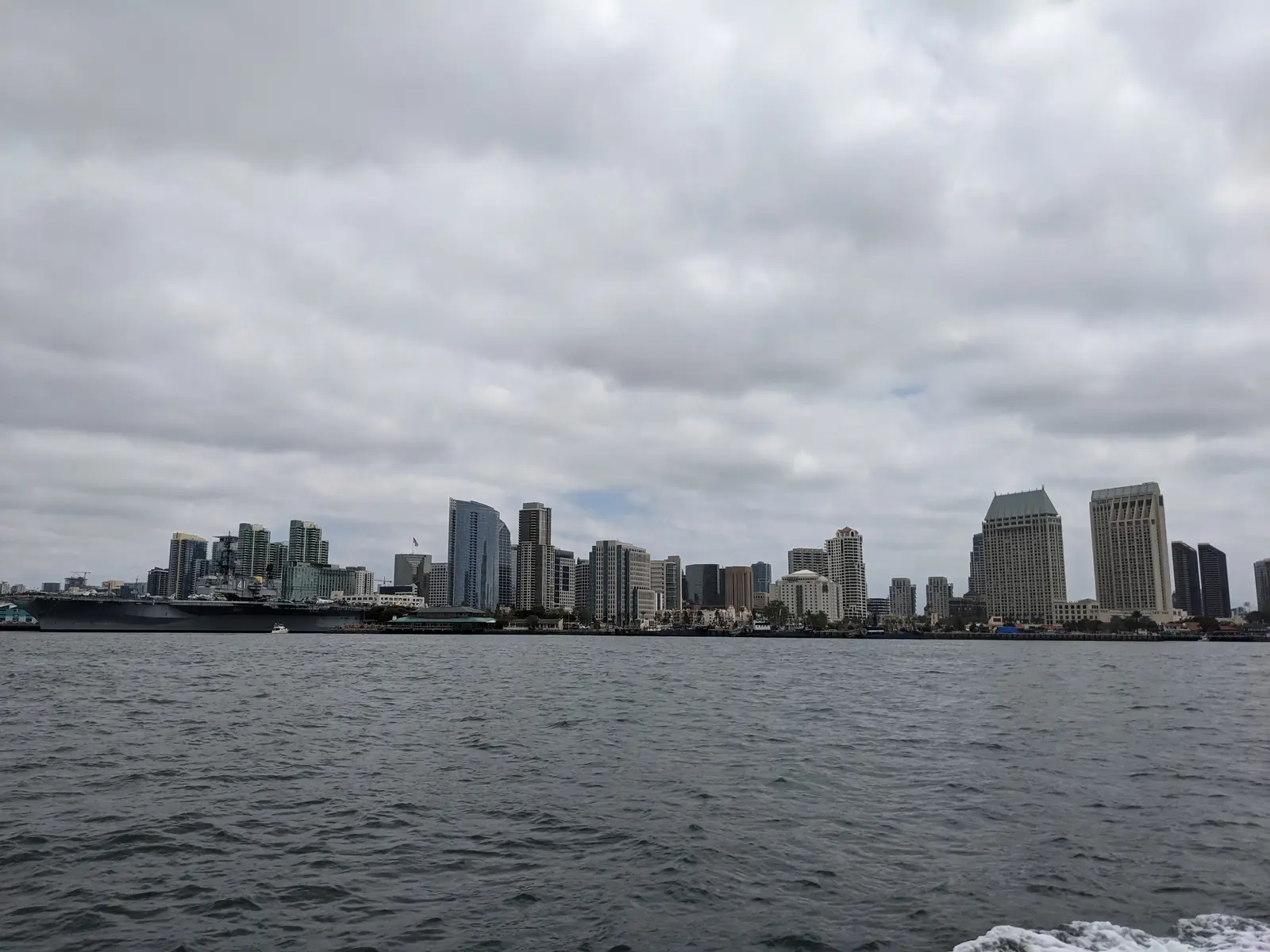
“Downtown San Diego Skyline bay” by Mds08011, CC BY 4.0, via Wikimedia Commons.
1. Ida Bailey and the Canary Cottage
What you’re looking at. The west side of Fourth Avenue, mid-block between Market and Island. No building from this era survives, and the parcel’s modern identity is genuinely disputed: the Horton Grand Hotel claims Canary Cottage stood on its present site at 311 Island Avenue, while historian Elizabeth MacPhail’s own account places it on Fourth, not Island. This page does not resolve that gap by inventing a coordinate.
The story. Somewhere on this block stood a story-and-a-half house painted a faded yellow, which is where its name came from: the Canary Cottage. The woman who ran it was named Ida Bailey, and by every account that survives her, she ran it like she meant to be believed. Good food, good drink, no heavy makeup on the women who worked there, no smoking, and a bouncer for any gentleman who forgot he was supposed to act like one. Her clientele included some of the best names in San Diego, men whose wives read about the 1912 raid the next morning and recognized nobody.
On the morning of November 10th, 1912, Police Chief Keno Wilson took thirty patrolmen through the sixteen square blocks of the Stingaree and arrested 138 women, Ida Bailey included. Each was fined a hundred dollars, and the fine was suspended on one condition: be on the three o’clock train out of San Diego.
Here is the part almost nobody tells you, because it doesn’t flatter the legend the way “the most famous madam in San Diego” does. Ida Bailey did not disappear into a comfortable retirement. She died years later, a few blocks from this spot, in genuine poverty. The one detail that survives her is that the city’s firefighters made sure her Christmas basket that year was the full one, not the half one they gave when supplies ran short. Canary Cottage itself stood until 1966, when the San Diego Union ran the demolition news under a headline that reads more like an obituary than a wrecking notice: “Sad Passing of Canary Cottage.”
The one detail that survives her is that the city’s firefighters made sure her Christmas basket that year was the full one.
A word on Wyatt Earp. He is sometimes said to have lived at the Horton Grand for seven years. MacPhail’s own research places his three actual San Diego gambling halls elsewhere on Fourth and near Sixth and E, and the 1888 city directory lists his occupation plainly as “Capitalist.” He may well have walked this block. Nobody has ever found a document putting him inside Canary Cottage.
The skeptic’s corner
Ida Bailey’s operation, clientele, the 1912 raid, her later poverty and the 1966 demolition all trace through MacPhail’s 1974 article, itself built on the unpublished memoirs of Walter Bellon, the city’s own Health Inspector, who personally oversaw the district’s closure. Canary Cottage standing on the Horton Grand’s present footprint is the hotel’s own claim about its own ground, not an independent historian’s; MacPhail describes a block face on Fourth, not Island. No ghost story attaches to this stop in any source located this pass; what’s told here is history, not a haunting.
2. The Tub of Blood Corner
What you’re looking at. The intersection of Third Avenue and Island Avenue.
The story. Two saloons once faced each other across this intersection, named by somebody daring the other to be believed. On the southwest corner stood the Old Tub of Blood. Directly across, on the southeast corner, stood the Seven Buckets of Blood. Behind them ran two rows of one-room cribs where the women of the Stingaree worked, roughly twenty rooms and about fifty women working them in shifts.
A man named Pete Cassidy ran the operation for years. The San Diego Union arrested him in March 1887 for “rolling a drunk,” relieving an unconscious man of seventy-five cents, and called him “a bruiser by trade and rough by reputation.” He later ran a side business collecting Navy bounties for turning in deserters, and two men working for him once blocked the city’s Health Inspector and the district attorney at the compound’s gate with pistol butts showing. What happened to Cassidy afterward has never turned up in the record, and this page does not invent him an ending.
Police believed men wanted elsewhere in the city would duck into this block and simply not come out the other side; Bellon thought the cribs had blind rooms built in for that purpose. When workmen tore the crib block down, they reported finding silver and roughly 250 empty beer bottles cached under the floorboards. The Old Tub of Blood itself came down on October 2nd, 1915, and the San Diego Sun covered the demolition that same day, closing its piece with a line worth repeating: none of the district’s falling landmarks had more real history attached to them than the shanty that went down that morning, “and which is now only a memory.”
What people say happens here. No ghost story is attached to this corner in any source located. That absence is reported here as a finding, not a gap to paper over.
The skeptic’s corner
The two saloons’ names and positions, and the October 1915 demolition date, trace through MacPhail’s 1974 article and the San Diego Sun‘s own contemporary coverage. The corrected crib count, Cassidy’s arrest record and the Navy bounty business come from Jeff Smith’s 2009 San Diego Reader series. The blind-room theory is Bellon’s own inference, not a documented fact. This is a district built on the sale of women, some of them teenagers by their own account, and this page excludes a piece of period-racist transcribed dialect that appears in Bellon’s memoirs concerning a Chinese resident of this block; that line is left out entirely, not softened.
3. Ah Quin’s Corner
What you’re looking at. Third Avenue and J Street, inside the Asian Pacific Thematic Historic District. The San Diego Chinese Historical Museum is a short walk away at 404 Third Avenue.
The story. Stand here and you’re standing where a man named Ah Quin ran a restaurant, raised a large family, and became, by every account that survives, the closest thing this neighborhood had to a mayor. He arrived in San Diego around 1879, a Chinese labor contractor who went on to supervise hundreds of the men who built the railroad bed running north toward San Bernardino, then settled at this corner and stayed.
Walter Bellon, the city’s Health Inspector, credited Ah Quin with much of whatever order the district managed to keep and said he never touched the trade his own neighborhood was known for elsewhere. San Diego’s police chief at the time, Keno Wilson, the same man who led the raid on the Stingaree two blocks from here, said flatly that Ah Quin was the finest Chinese man he had ever known. In 1914, a motorcycle struck and killed him at this corner. By that point he was among the wealthiest Chinese men in Southern California.
Ah Quin kept diaries for decades. They’re held today at the San Diego History Center and described by the people who catalog such things as one of the few surviving first-person records, anywhere in California, written by a Chinese immigrant of his era in his own words rather than a newspaperman’s. Nobody researching this page has read them, and as far as this page can determine, nobody who has ever sold a ghost tour of this city has opened them either. This stop exists to point at where they are.
One thing this stop won’t do. You may hear elsewhere that a tunnel network once ran beneath this neighborhood, connecting basements under the street. What’s actually documented is hidden rooms and concealed doors inside individual buildings, not a connected underground network, and this page does not ship the tunnel claim as fact.
The skeptic’s corner
Ah Quin’s arrival, his restaurant and residence at this corner, his 1914 death and the Wilson and Bellon quotes trace through Bellon’s memoirs as reported in MacPhail’s 1974 article. No primary 1914 death notice has been pulled from the San Diego Union to fix an exact date, which would move this from secondhand memoir to contemporary record. No ghost story is attached to this stop.
4. Santa Fe Depot
What you’re looking at. 1050 Kettner Boulevard, on the north side of Broadway at Kettner.
The story. For a century-old railroad station in a tourist city, this one has no ghost story attached to it anywhere in the record, and that absence is worth saying plainly under the twin domes. What it has instead is a grudge. San Diego spent decades, starting in 1845, trying to become the West Coast’s terminus for a transcontinental railroad. Los Angeles won that fight. What San Diego got instead was this: a genuinely beautiful station on what amounted to a branch line.
The building in front of you opened in March 1915, timed to the Panama-California Exposition then running in Balboa Park, replacing a small Victorian frame depot on this exact ground that the first transcontinental train pulled into on November 17th, 1885. Architects Bakewell and Brown, the same San Francisco firm behind San Francisco’s own City Hall, gave this one its Mission Revival domes to match the Exposition buildings a few miles east.
In the early 1970s, Santa Fe itself, the railroad whose name is on this building, proposed tearing it down. What saved it was a listing on the National Register of Historic Places in June 1972, and the railroad that had wanted it gone ended up refurbishing it instead. Walk to the south end of the building and look across Broadway. There used to be a covered patio there in the original 1915 photographs. It’s a parking lot now, and that’s not a metaphor, just what happened to it.
The skeptic’s corner
The 1915 opening, the replaced 1887 depot, the architects and the 1972 National Register listing are documented through the Journal of San Diego History and the National Register itself. Sources split on the exact opening day, March 7th or 8th, 1915, and this page doesn’t pick one. No ghost story is traced to this building in any source located.
5. The U.S. Grant Hotel, and the Horton House Underneath It
What you’re looking at. 326 Broadway, on the north side of Broadway at Third.
The story people tell. Fannie Josephine Chaffee Grant, whose money put this hotel on this ground, died before it ever opened and never saw it finished. She’s said to walk the halls in an old-fashioned white dress, most often on the fifth floor, with housekeeping reporting objects moving the moment their backs are turned and staff avoiding the ballroom alone.
This page looked hard for where that story actually started and came up empty. It appears across a dense mat of haunted-hotel roundups and blog posts that all cite each other and nothing else: no book, no newspaper, no historical society mention, and no traceable first telling anywhere. Fannie Grant died on November 10th, 1909, eleven months before the hotel opened. The versions of the story where she dies inside the finished building are contradicted flatly by that date; the versions where she simply never lived to see it finished are the ones the record actually supports, and honestly, they’re the better story anyway.
What’s actually underneath this ground. Alonzo Horton’s own hotel, the Horton House, stood here for twenty-five years starting in 1870. Fannie Grant bought it in 1895 and later willed it to her husband, Ulysses S. Grant Jr., son of the president, who wanted to tear it down and build a monument to his father. On the evening of July 12th, 1905, the first bricks came out by the hands of Alonzo Horton, Ephraim Morse and William Bowers themselves, the same three men who’d laid the original cornerstone decades earlier, while a crowd watched from the Plaza.
Then almost nothing happened for years. The 1906 San Francisco earthquake consumed the West Coast’s lumber supply, and the 1907 financial panic stopped construction outright; a bare concrete skeleton stood on Broadway, by one contemporary’s own words, as “a blight on the downtown area,” until a banker named Louis Wilde raised the money to finish it. The hotel finally opened October 15th, 1910, with 437 rooms. Of the three men who pulled those first bricks in 1905, only Bowers lived to see it open.
A bare concrete skeleton stood on Broadway, by one contemporary’s own words, as “a blight on the downtown area.”
Grant’s money to build all of this traces back to one of the largest financial frauds of the nineteenth century: a Wall Street firm bearing his own name, which collapsed in 1884 when his partner, Ferdinand Ward, was caught running what amounted to a swindle on veterans and millionaires trading on the Grant name. Ward went to prison for ten years. Grant’s own father wrote his memoirs, dying of throat cancer, specifically to rebuild the family’s finances, and it was the royalty money from that book that helped pay for the hotel standing in front of you.
The skeptic’s corner
The Fannie Grant ghost is told here deliberately, per this page’s standing rule that a story a competitor tells is worth naming and doubting rather than leaving out silently. It is not attributed to any single operator; it appears across too broad and generic a spread of haunted-hotel content to name one company. Fannie Grant’s death date and the Horton House demolition scene are documented through Evelyn Banning’s account in the Journal of San Diego History, as are the construction gap, the earthquake and panic, and the Grant and Ward fraud.
6. Horton Plaza Park, the Clock That Isn’t Here, and the Fountain That Is
What you’re looking at. Horton Plaza Park, bounded by Broadway, Third Avenue, Fourth Avenue and E Street.
The story. Stand at the fountain and face north toward the U.S. Grant Hotel. What you’re standing in the middle of is three separate absences stacked on the same city block. Start with the clock, the best-told legend in this file, even though it isn’t standing here anymore. A young watchmaker named Claude Ledger spent fifteen months building it, starting in 1906, for a jeweler named Jessop who’d seen a street clock in Bern, Switzerland, and wanted one of his own. Ledger guarded that clock for the rest of his life, checking its every movement personally. He developed arthritis, went to the desert for the dry heat, and died on one of those trips. On that same day, the clock stopped, for no reason anyone has ever identified. The Jessop family says this story ran nationally in Ripley’s “Believe It or Not.”
The fountain in front of you is real and still here. Architect Irving Gill designed it, modeled on a fourth-century-B.C. monument in Athens, donated by the same Louis Wilde who’d just finished paying to complete the U.S. Grant Hotel across the street. It was dedicated October 15th, 1910, the same day the hotel opened. This ground has been San Diego’s front yard since 1870, when Alonzo Horton cleared it for public use; President Benjamin Harrison spoke here to five thousand people in 1891.
The clock moved twice, once in 1927 and once in 1984, when it finally landed at Horton Plaza, anchoring the shopping mall built around it the following year. Its rental agreement there ended in 2012, and it was dismantled and put in storage in 2019. The Jessop family still owns it, with plans someday to reassemble it at the San Diego History Center in Balboa Park. The shopping mall it once anchored has itself been gutted and redeveloped.
The skeptic’s corner
The clock stopping the day its builder died is folklore, well provenanced, told by the Jessop family itself in a 1987 historical-society article. The fountain’s design, donor and 1910 dedication date are documented and match the hotel’s own opening day independently. The Jessop family’s own 1987 article gives two different counts for the clock’s dial number, twenty and twenty-one, and this page treats that drift as evidence of a living tradition rather than an error to fix.
7. Spreckels Theatre
What you’re looking at. 121 Broadway. Closed since 2021; view the exterior only.
The story. Nothing traceable has ever turned up connecting this building to a ghost, and for a 114-year-old theatre in a city this fond of hauntings, that’s worth one honest sentence rather than a manufactured one. What it has instead is a number joke that’s real: it was built with exactly 1,915 seats, chosen on purpose to match the year of the Panama-California Exposition then going up in Balboa Park.
John D. Spreckels built it. By the 1910s he effectively owned San Diego: two of its three daily newspapers, its streetcar system, the ferry to Coronado, the Hotel del Coronado, and at one point ten percent of all property tax collected in the county. He hired architect Harrison Albright, the same man who designed the U.S. Grant Hotel two blocks east for Spreckels’s rival money man, and the theatre opened August 23rd, 1912, marketed as “the first modern commercial playhouse west of the Mississippi,” with a column-free auditorium so no seat had an obstructed view of the stage.
Enrico Caruso, John Barrymore, Al Jolson and Will Rogers all played this stage. It converted to a movie house in 1931 and was restored to live theatre in 1976 by the original owner’s own daughter. When fire destroyed the Old Globe Theatre in 1978, this building hosted the Globe’s entire next season. It sold in 2021 for $26.5 million and has stood dark since.
The skeptic’s corner
The 1912 opening date, architect and Spreckels’s ownership are documented through the National Register nomination and the Journal of San Diego History. The performer list and 1976 restoration rest on a single secondary account whose original citation is now a dead link. No ghost story, in any form, is attached to this building in any source located.
8. El Cortez Hotel and Cortez Hill
What you’re looking at. 702 Ash Street, at Seventh Avenue and Ash. People live here now; this building is residential condominiums, not a hotel. This page anchors on the public sidewalk and describes the neighborhood at area level only.
The story. This building was saved by having the part everybody actually remembered removed from it, which is a stranger, truer preservation story than most ghost tales this city tells. It went up on the site of a Victorian mansion built in 1887 for Ulysses S. Grant Jr., the same man behind the hotel bearing his name a few blocks away; his wife Fannie bought the house for $25,000 in gold in 1893. The hotel that replaced it opened Thanksgiving 1927, fourteen stories rising 310 feet above a 175-foot hill, taller than anything else in the city at the time.
On the night of December 7th, 1941, Marines surrounded this building with fixed bayonets to protect the high officials sheltering inside, and an anti-aircraft battery and radar station went up on the roof the next morning. In 1956, the hotel installed the second operational exterior glass elevator in the world, the first built on a hydraulic ram instead of a cable; both Otis and Westinghouse had refused the job, and a three-partner local firm worked out the concept over four hours and fifty napkin drawings at a nearby restaurant. People lined up out of the lobby just to ride it, and two members of the city’s own Historic Site Board later argued to save that elevator specifically because they’d each spent their prom night riding it.
They lost that argument. The hotel closed in 1978 and sat empty. When the city moved to save the exterior from demolition in 1990, the National Park Service weighed in on the other side, calling the removal of the glass elevator, the Sky Room and the Cotillion Room “commendable,” on the theory that restoring the building to its original 1927 appearance was the correct preservation outcome. The federal criteria won. The building standing here now was saved by deleting the exact thing that made two separate people choose it for their prom night.
The skeptic’s corner
The 1927 opening, the Grant mansion beneath it, and the 1956 glass elevator’s construction and 1990 removal are documented through the Journal of San Diego History. The prom-night testimony and a busboy’s memory of an ice-skating publicity stunt are named, dated oral history rather than documents. No ghost story is attached to this building in any source located. A 1950 incident preserved in the historical record, in which a hotel manager recounted a woman fleeing a room naked after unwanted advances, told at the time as a joke, is excluded from this page entirely; it is an account of sexual assault told as a punchline and this page gains nothing by repeating it.
9. The Tenth Avenue Arts Center
What you’re looking at. 930 Tenth Avenue, a working performing-arts venue, publicly accessible.
A note before this one. This stop names a suicide and a child’s death, both undocumented as fact and both drawn from the same 1997 oral tradition. Neither is skipped or softened for being what it is, and neither is described past what’s needed to tell it honestly. Crisis resources: 988 Suicide and Crisis Lifeline, call or text 988.
The story. The single most useful fact in this entire stop isn’t a ghost, it’s a date. In 1997, the venue’s current owner bought this building from the congregation that had used it for seventy years. As they hauled their belongings out, some of the departing First Baptist Church members told him the building was haunted. He said so himself, on the record, years later: “The stories were passed on to us from some of the First Baptist Church folks as they were hauling their stuff out of the building back in ’97.” That means this legend’s origin can be dated almost to the week, which most hauntings in this city can’t claim.
The building opened in 1928 as a chapel, funded by an anonymous church donor so sailors coming into port at three in the morning would have somewhere to pray without anyone needing to unlock the main sanctuary next door. It served Boy Scout troops and church youth groups for decades, including on a fenced rooftop recreation deck.
The stories that came out the door in 1997 settled into four figures, later chronicled at book length by paranormal investigator Alex Matsuo, who first encountered the building as a college student using it as cheap rehearsal space: a British Navy lieutenant said to have died of a heart wound during the Second World War, whose ghost still barks marching orders; a young girl sometimes said to have died on the rooftop deck in the 1960s after shouting “catch me if you can” and falling down a stairwell; a former congregation member named Carol, whose funeral was held in this building and who’s said to still object, from the fourth floor, to untidy bathroom stalls; and a pastor the story says couldn’t live with what happened to the girl, found dead by his own hand in a room off the altar on the morning of Monday, November 25th, 1963, three days after President Kennedy was shot.
Here’s where this stop earns its place on this page. This project checked. Two San Diego dailies were searched for any record of a First Baptist pastor’s death across the three weeks surrounding that date. What turned up instead was a page from the San Diego Union and Daily Bee, dated November 25th, 1963, the exact day the legend claims the pastor died, quoting the actual pastor of First Baptist Church of San Diego, the Reverend Dr. Pieter Smit, speaking about the national mourning for the president. His own words, in print, that morning: “Our cup runneth over with sorrow and remorse.” He was alive. He was preaching. He was giving interviews to the newspaper. Records suggest he lived into his nineties.
He was alive. He was preaching. He was giving interviews to the newspaper.
This page isn’t going to tell you the pastor never existed, or that the story is false; that’s a stronger claim than this research supports. What can be told, and what nobody who’s ever sold a tour of this building has told you, is that the pastor the story usually gets attached to was alive and preaching, in this city, in this newspaper, the very week he’s said to have died in this building.
The skeptic’s corner
The 1997 property-handover origin of the entire haunting canon is on the record from the building’s own current owner. All four ghosts, the lieutenant, the girl, Carol and the pastor, are rumor, none independently corroborated beyond the tradition Alex Matsuo became the primary chronicler of starting from the same 1997 handover. The pastor’s death is contradicted narrowly and specifically: a contemporary newspaper places him alive and giving an interview on the exact date the legend gives for his death. This page does not describe or endorse the “provocation” method some investigators use to try to draw a response from the Carol entity, deliberately leaving the venue’s working restrooms untidy; this is a real, currently operating business and its bathrooms are not a prop.
10. Where the Third County Courthouse Stood
What you’re looking at. The block bounded by Front, Union, Broadway and C Street. The nearest standing landmark is the Hall of Justice, 330 West Broadway.
The story. There is nothing historic standing here now, and that absence is the entry. San Diego has had five county courthouses, each built because the last one failed in some way, and this block held the grandest of them: an Italianate building with a bell and clock tower, statues of four presidents, and, on its very top, a ten-foot gilded statue of Justice. Its completion is dated to either 1889 or 1892 depending which record you trust, and its demolition to either 1959 or 1961, same problem, same solution: both named, neither resolved.
Two pieces of that building outlived it. Forty-two clerestory stained-glass windows, one for each state then in the Union’s Great Seal, were saved before the wrecking crew arrived, sat in storage for thirty-five years, and were finally installed in the Hall of Justice when it was completed in 1996. The gilded Justice statue that once stood on the roof was reportedly taken down over fears it might fall after the 1906 San Francisco earthquake, four hundred miles away; that detail rests on a single source and would need independent confirmation before it’s treated as settled. She’s on display today at the San Diego History Center in Balboa Park, at the entrance to an exhibit on women in law.
The skeptic’s corner
This stop is sourced and openly contested on two specific dates it names rather than resolves: the third courthouse’s completion year and its demolition year. The Justice statue’s removal being tied to the 1906 earthquake is single-source. No folklore or ghost story is traced to this location in any source found.
11. Old Police Headquarters, Jail and Courts
What you’re looking at. 789 West Harbor Drive, now operating as The Headquarters at Seaport Village.
The story. For a forty-eight-year working police station and jail that’s since been converted into a shopping and dining center where you can walk directly into a preserved cell block, this building has, as far as this page can determine, no ghost story attached to it anywhere. That’s faintly remarkable, and worth stating plainly rather than inventing one to fill the gap.
Built in 1938 and 1939 by architects Charles and Edward Quayle with Alberto Treganza, funded through New Deal public-works money, this complex served as San Diego Police Department headquarters from 1939 until 1987, with a garage, a gymnasium, courtrooms and an eight-cell jail block behind an arched Spanish Colonial Revival entrance the National Register nomination says “defined San Diego and Southern California” as a civic style. It sat mostly empty afterward and faced serious demolition proposals in the early 2000s before preservation advocates fought to list it among the city’s endangered properties. It made the National Register in 1998, and an adaptive reuse project reopened the building in 2013. The original eight-cell jail block wasn’t hidden or removed; it was restored and kept exactly where it always stood, as a public walk-through exhibit lined with the department’s own historic photographs.
The building didn’t have its past demolished to make room for shops. It had shops built around its past, on purpose, and today you can eat lunch in what used to be a jail.
The skeptic’s corner
The construction date, architects, 1939-1987 service as SDPD headquarters and the 1998 National Register listing are documented through the National Register nomination itself. The 2013 adaptive reuse and preserved jail block are visible on site today. No ghost story or haunting claim has turned up for this building in any source located.
Frequently asked questions
Is Downtown San Diego actually haunted? Most of its documented history has no ghost story attached at all, from the Santa Fe Depot to Spreckels Theatre to the old police headquarters at Seaport Village. Where a haunting is told, like the Tenth Avenue Arts Center’s four-ghost canon or the U.S. Grant Hotel’s Fannie Grant legend, this page names it as folklore and tells you exactly how far the sourcing goes.
What’s the most documented story on this page? Ida Bailey’s real life: a named madam, a dated 1912 police raid, and her own later poverty, traced through a historical society article built on a city health inspector’s unpublished memoirs. No ghost is attached to it. It’s simply true.
Is the Tenth Avenue Arts Center really haunted? Its owner is on the record dating the entire haunting tradition to 1997, when the previous congregation moved out. A contemporary 1963 newspaper contradicts the specific detail that the pastor in the story died that week; he was alive and giving interviews. The other three figures in the canon remain unverified rumor, told honestly as rumor here.
Was Wyatt Earp really part of Downtown’s history? He ran three actual gambling halls in San Diego, documented on Fourth Avenue and near Sixth and E, and the 1888 city directory lists his occupation as “Capitalist.” No document has ever placed him inside the Canary Cottage or the building that became the Horton Grand, despite that claim circulating widely.
Why do some stops on this page have no ghost story at all? Because that’s what the research found. This page reports an honest absence rather than inventing a haunting to fill a gap, at the Santa Fe Depot, the Tub of Blood corner, Spreckels Theatre, the old county courthouse site and the old police headquarters alike.
Several of these stops sit inside the same blocks covered after dark on the San Diego Gaslamp and Old Town Haunted Ghost Tour, told by a guide who can name the source for you on the spot. For a wider loop through Downtown’s landmarks, including several covered on this page, see the Haunted San Diego Ghost Bus. For more sourced stories from across the city, start at San Diego Ghost Stories.
Exploring other neighborhoods? Balboa Park, Coronado, the Embarcadero, Gaslamp Quarter, Hillcrest and Bankers Hill, La Jolla, Little Italy, Mission Hills, Mission Valley, North Park and Golden Hill, Old Town, and Point Loma each have their own guides too: Balboa Park, Coronado, the Embarcadero, Gaslamp Quarter, Hillcrest and Bankers Hill, La Jolla, Little Italy, Mission Hills, Mission Valley, North Park and Golden Hill, Old Town, and Point Loma.
Sources
- Elizabeth C. MacPhail, “Shady Ladies in the ‘Stingaree District’: When the Red Lights Went Out in San Diego,” Journal of San Diego History, Spring 1974, Vol. 20 No. 2, built on the unpublished memoirs of Walter Bellon, San Diego’s City Health Inspector, held at the Serra Museum Research Library, San Diego History Center. Source for Ida Bailey’s operation and the 1912 raid (Stop 1), the Tub of Blood corner and Pete Cassidy (Stop 2), and Ah Quin’s corner (Stop 3).
- San Diego Union, November 10 to 12, 1912, raid coverage, cited in MacPhail.
- Jerry MacMullen, “Sad Passing of Canary Cottage,” San Diego Union, January 9, 1966, p. G3.
- Horton Grand Hotel’s own published history (hortongrand.com), for the claim that Canary Cottage stood on the hotel’s present site. Cited as the hotel’s own claim about its own ground, not an independent historian.
- San Diego Sun, October 2, 1915, Old Tub of Blood demolition coverage.
- San Diego Union, November 3, 1887, undercover reporter’s account of lower Fifth Avenue.
- Jeff Smith, “Unforgettable: A Walk on the Stingaree Side,” San Diego Reader, Parts 1, 2 and 4, July 2009. Source of the corrected crib count, Cassidy’s 1887 arrest record and the Navy bounty business (Stop 2).
- Richard F. Pourade, The Glory Years (San Diego Union-Tribune Publishing, 1964), p. 230, for Ah Quin (Stop 3).
- San Diego Chinese Historical Museum, holdings record on Ah Quin, for the diaries’ existence and location.
- James N. Price, “The Railroad Stations of San Diego County,” Journal of San Diego History, Spring 1988, Vol. 34 No. 2, for the Santa Fe Depot (Stop 4).
- Evelyn I. Banning, “U.S. Grant, Jr.: A Builder of San Diego,” Journal of San Diego History, Winter 1981, Vol. 27 No. 1. Source for the Santa Fe Depot’s first transcontinental arrival (Stop 4), the U.S. Grant Hotel and Horton House (Stop 5), and the El Cortez Hotel’s Grant-mansion history (Stop 8).
- “Santa Fe Depot (San Diego),” Wikipedia, for National Register and landmark dates (Stop 4).
- National Register of Historic Places, ref. 72000248 (Santa Fe Depot, Stop 4).
- Mary Maud Burnham, “San Diego’s Horton Plaza,” Journal of San Diego History, Fall 1974, Vol. 20 No. 4, for Stops 5 and 6.
- A dense, uncredited spread of haunted-hotel listicle and roundup sites, none independently corroborating any other, named as a category rather than individually: source of every version of the Fannie Grant ghost claim (Stop 5). No single company is named because no single company can honestly be blamed for originating it.
- “U.S. Grant Hotel,” Wikipedia, for the opening date and National Register listing (Stop 5).
- Joseph E. Jessop, “The Jessop Street Clock,” Journal of San Diego History, Winter 1987, Vol. 33 No. 1 (Stop 6).
- Uldis Ports, “Geraniums vs. Smokestacks,” Journal of San Diego History, Summer 1975, Vol. 21 No. 3, for Louis Wilde’s 1917 mayoral race (Stop 6) and John D. Spreckels’s broader holdings (Stop 7).
- “Jessop’s Clock,” Wikipedia, for the 2012 lease end and 2019 storage dates (Stop 6).
- “Spreckels Theatre,” Wikipedia (Stop 7).
- National Register of Historic Places, ref. 75000467 (Spreckels Theatre, Stop 7).
- Kyle E. Ciani and Cynthia Malinick, “From Spanish Romance to Neon Confidence and Demolition Fear: The Twentieth Century Life of the El Cortez Hotel,” Journal of San Diego History, Winter 2000, Vol. 46 No. 1 (Stop 8).
- sandiegohaunted.com, “10th Avenue Theater Arts Center Ghost,” for the building owner’s 1997 property-handover quote and the four-ghost canon as first collected (Stop 9).
- Association of Paranormal Study, “Tenth Avenue Theatre, San Diego, CA,” captured via web archive, 2026-08-16 (Stop 9).
- Alex Matsuo, The Haunting of the Tenth Avenue Theater (Llewellyn Worldwide, Woodbury, Minnesota, October 2015), now out of print (Stop 9).
- Alex Matsuo, interview, Spirit Radio: The Paranormal Experience, WSCA 106.1 FM, aired December 19, 2015, cited only as evidence of what she said and when (Stop 9).
- The San Diego Union and Daily Bee, November 25, 1963, p. 27, GenealogyBank. Source of the Reverend Dr. Pieter Smit quote (Stop 9).
- Evening Tribune, November 26, 1963, p. 32, GenealogyBank, checked for a matching First Baptist death notice; the only First Baptist item on this page concerns a different congregation (Stop 9).
- tenthavenuearts.com, the venue’s own history page, for the 1928 chapel construction and its military-worship origin (Stop 9).
- 988 Suicide and Crisis Lifeline, available by call or text, any hour.
- “San Diego County Superior Court,” Wikipedia, for the third county courthouse (Stop 10).
- California Supreme Court Historical Society, county-courthouse entry for San Diego County (Stop 10).
- Superior Court of California, County of San Diego, “A Tribute To San Diego County Courts Of The Past,” for the stained-glass window details (Stop 10).
- City of San Diego Digital Archives, “San Diego County Courthouse circa 1910” (Stop 10).
- noehill.com, “National Register #98000833: Old San Diego Police Headquarters, Jail & Courts,” adapted from the 1998 NRHP nomination (Stop 11).
- The Headquarters at Seaport Village, “About,” the current operator’s own history page (Stop 11).
- Save Our Heritage Organisation, “Once Endangered: Old Police Headquarters,” cited as a party to the preservation fight, not a neutral historian (Stop 11).
- National Register of Historic Places, ref. 98000833 (Stop 11).
Take the tour
- Haunted San Diego Ghost Bus
- Gaslamp and Old Town Haunted Ghost Tour
- Paranormal Investigation History Tour
- Private Group Tours